

Colorado has imposed new restrictions on the manufacture, distribution, transfer, sale, and purchase of certain semiautomatic firearms. Under Senate Bill 25-003, beginning August 1, 2026, a person may face criminal charges for knowingly engaging in one of these activities with a “specified semiautomatic firearm” unless a statutory exception applies.
The law does not prohibit every semiautomatic firearm, and it does not make continued possession of a previously acquired firearm a crime under this particular provision. Instead, it creates detailed rules governing covered firearms and transactions. A first violation is a class 2 misdemeanor, while a second or subsequent violation is a class 6 felony.
Anyone accused of violating the new law should avoid making assumptions based only on the firearm’s appearance or common name. A Denver weapons charges lawyer can examine the firearm, transaction records, training history, applicable exceptions, and what the accused person allegedly knew.
What Does Colorado SB 25-003 Prohibit?
Under Colorado Revised Statutes § 18-12-116, it is unlawful to knowingly:
- Manufacture;
- Distribute;
- Transfer;
- Sell; or
- Purchase
a specified semiautomatic firearm on or after August 1, 2026, unless the conduct falls within an exception.
The word “knowingly” is important. A criminal case should not turn solely on whether a firearm was involved. Prosecutors must establish the required mental state as well as the characteristics of the firearm, the nature and timing of the transaction, and the absence of an applicable exception.
Which Firearms Does the New Colorado Law Cover?
The law generally defines a specified semiautomatic firearm as:
- A semiautomatic rifle with a detachable magazine;
- A semiautomatic shotgun with a detachable magazine; or
- A gas-operated semiautomatic handgun with a detachable magazine.
An attached tubular magazine located beneath a firearm’s barrel is not treated as a detachable magazine under the statute.
The law also excludes several firearm categories, including:
- Firearms designed to operate only with .22-caliber or smaller rimfire ammunition, unless the firearm has separate upper and lower receivers;
- Firearms operated manually by bolt, pump, lever, or slide action;
- Firearms with permanently fixed magazines that cannot accept more than 15 rounds;
- Certain single- or double-action semiautomatic handguns that use recoil to cycle their actions;
- Firearms made permanently inoperable;
- Antique firearms and qualifying curios or relics; and
- Certain firearm models specifically identified by the statute.
Because firearm design and configuration can determine whether the law applies, model names alone may not provide a reliable answer. The Colorado Firearms Dealer Division publishes guidance addressing specific firearm models, which is available through the Colorado Parks and Wildlife specified semiautomatic firearms page.
What Transactions Are Exempt From SB 25-003?
Even when a firearm falls within the statutory definition, the transaction may be exempt.
A person may sell or transfer a covered firearm to an individual residing outside Colorado or to a federally licensed firearms dealer. Other exceptions apply to certain transactions involving:
- Law enforcement agencies and qualifying peace officers;
- The Colorado Department of Corrections and detention facilities;
- The United States military and Colorado National Guard;
- Armored vehicle businesses;
- Gunsmiths and approved gunsmithing programs;
- Certain educational institutions;
- Historical societies, museums, and institutional collections;
- Forensic laboratories;
- Transfers occurring by operation of law or following a person’s death; and
- Firearms capable of firing only blanks when used solely as film props.
Whether an exception applies can depend on who participated, the purpose of the transaction, the firearm’s condition, and where the recipient resides.
Does the Law Affect Semiautomatic Firearms You Already Own?
SB 25-003 regulates specified transactions rather than continued ownership.
A person who lawfully acquired a covered firearm before August 1, 2026, is not required under this provision to surrender it, register it, or obtain an eligibility card merely to continue possessing it. The new requirements become relevant when someone later manufactures, distributes, transfers, sells, or purchases the firearm.
For example, selling or transferring a previously owned covered firearm to another Colorado resident may be regulated even though the current owner obtained the firearm before the law took effect.
What Is a Firearms Safety Course Eligibility Card?
The firearms safety course eligibility card is not final authorization to purchase a firearm. It allows the cardholder to enroll in the training required to qualify for certain purchases or transfers.
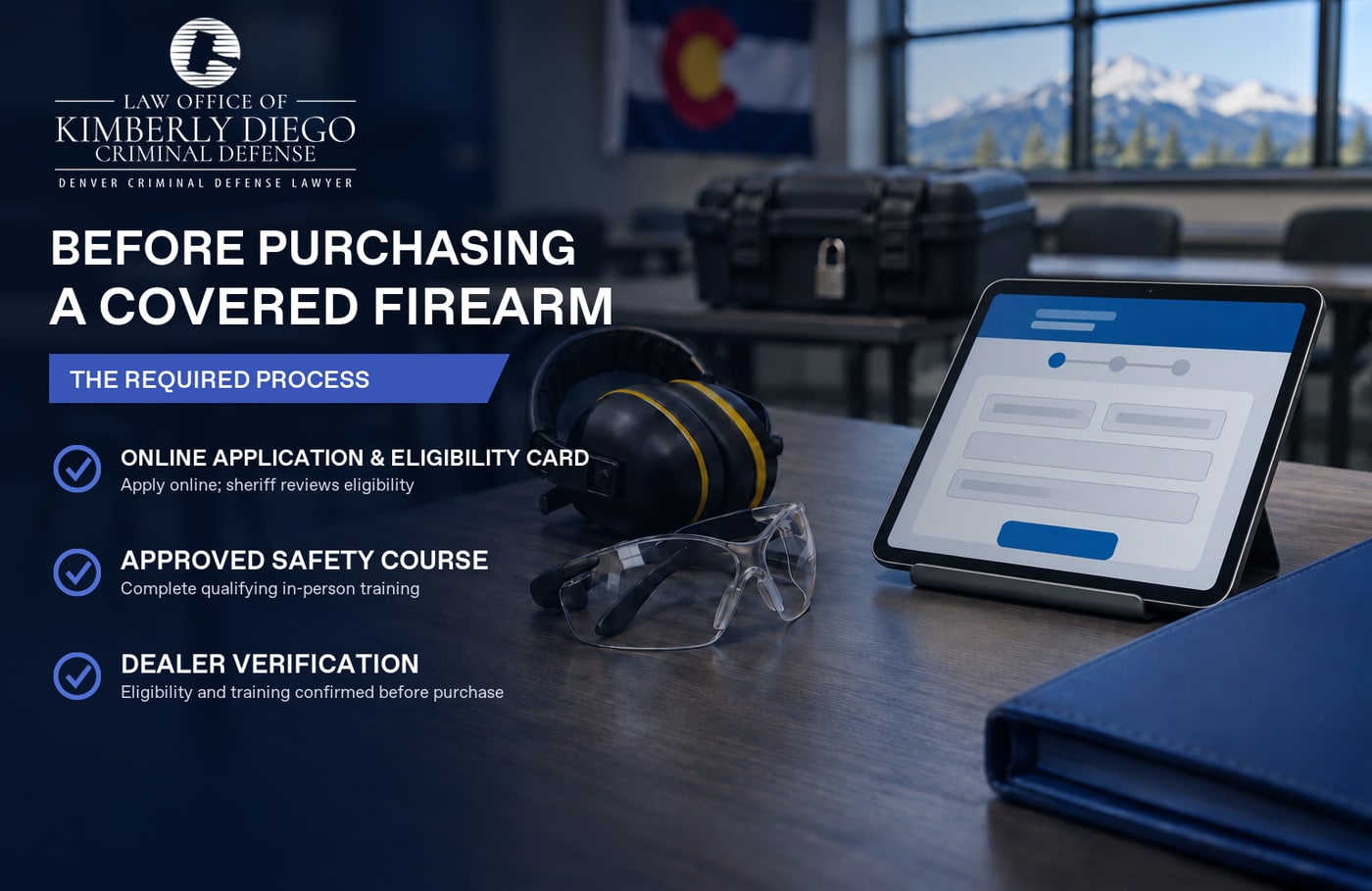
The process generally includes:
- Creating an application through the Colorado Firearms Safety System;
- Providing a government-issued photo ID and a qualifying name-based background check to the applicant’s county sheriff;
- Paying the Colorado Parks and Wildlife fee and any additional sheriff’s processing fee;
- Receiving an eligibility determination from the sheriff;
- Completing the applicable firearms safety course and examination; and
- Having a firearms dealer verify course completion through the state system before beginning the purchase.
The Colorado Parks and Wildlife record fee is currently $52. Individual sheriffs may charge an additional processing fee, and a private instructor may charge separately for the required course. The application fees are not refunded when an application is denied.
An eligibility card is valid for five years. Course completion also generally creates a five-year period during which a qualifying purchase can be made. Colorado Parks and Wildlife provides the current application process, course information, instructor resources, and fee details through its Firearms Safety Program.
Can a Sheriff Deny or Revoke an Eligibility Card?
A sheriff must deny an application if the applicant cannot legally possess a firearm under state or federal law or if the sheriff cannot positively identify the applicant.
A sheriff may also deny an application based on a reasonable belief that documented prior behavior makes it likely the applicant would present a danger to themselves or others. Similar grounds can support revocation after a card has been issued.
A person whose application is denied or whose card is revoked must receive written notice stating the grounds for the decision. The person can seek judicial review. During that review, the sheriff generally bears the burden of proving ineligibility. A heightened clear-and-convincing-evidence standard applies when the decision is based on the alleged danger the applicant presents.
Knowingly making a false or misleading statement—or deliberately omitting material information—on the application can lead to a separate second-degree perjury charge and revocation of an issued card.
What Firearms Training Does Colorado Require?
A prospective buyer generally qualifies through one of three training pathways:
- Completing a Colorado Parks and Wildlife-certified hunter education course and then completing a basic firearms safety course within five years before the purchase;
- Completing an extended firearms safety course within five years before the purchase; or
- Having completed an extended course more than five years earlier and then completing a basic course within the applicable five-year period.
The basic course requires at least four hours of in-person instruction. The extended course requires at least 12 hours of in-person instruction conducted over at least two days.
Courses address subjects including safe firearm handling, ammunition magazines, safe storage, child safety, extreme risk protection orders, mental-health-related firearm deaths, and victim awareness. Students must also pass the required examination and practical component with a score of at least 90 percent.
Concealed-carry courses and other firearm courses do not automatically satisfy the new requirements. The training must qualify under the SB 25-003 program.
What Are the Penalties for Violating Colorado’s Semiautomatic Firearm Law?
Unlawful manufacture, distribution, transfer, sale, or purchase of a specified semiautomatic firearm is:
- A class 2 misdemeanor for a first offense; or
- A class 6 felony for a second or subsequent offense.

A misdemeanor conviction under the statute can prevent the Colorado Bureau of Investigation from approving another firearm transfer during the following five years.
A felony conviction creates more serious consequences. Colorado specifically added a felony conviction under this law to the offenses that can support a possession-of-weapons-by-a-previous-offender charge. Federal law can also prohibit firearm possession following a felony conviction.
A licensed firearm dealer convicted of violating the statute also faces revocation of the dealer’s Colorado permit.
These consequences make resolving a case important. A plea that avoids incarceration could still affect future purchases, possession rights, employment, licensing, and other areas discussed in the firm’s Colorado criminal charge consequences FAQs.
Is SB 25-003 Still in Effect After the Court Challenge?
Yes. SB 25-003 remains in effect.
A group of Colorado residents and the Colorado State Shooting Association filed a federal lawsuit challenging the law under the Second Amendment. They asked the United States District Court for the District of Colorado to issue a preliminary injunction stopping enforcement of the permit-to-purchase system while the case continued.
On November 4, 2026, the court denied that request. The ruling means the law remains enforceable while the lawsuit proceeds. It was not a final judgment resolving every constitutional issue in the case. The federal court’s order denying the preliminary injunction is publicly available through GovInfo.
Anyone involved in a pending investigation or transaction should rely on the law’s current enforceable requirements rather than assuming that the lawsuit suspended them.
What Defenses May Apply to a Semiautomatic Firearm Charge?
The appropriate defense depends on the firearm, transaction, records, and circumstances. Important questions may include:
- Did the accused person act knowingly?
- Does the firearm meet the statutory definition?
- Was the magazine actually detachable?
- Does a firearm-specific or transaction-specific exception apply?
- Did the alleged conduct occur on or after August 1, 2026?
- Had the purchaser completed a qualifying training pathway?
- Did state, instructor, sheriff, or dealer records incorrectly report the person’s status?
- Was the firearm obtained during an unlawful search or seizure?
- Can prosecutors prove who manufactured, transferred, sold, or purchased the firearm?
Course records, eligibility-card information, dealer documentation, communications between the parties, firearm specifications, and the state’s model guidance may all become important evidence.
When police obtain the firearm or related records through an unconstitutional search, defenses based on challenging an unlawful search in a Colorado gun case may also be available.
Talk to a Denver Weapons Charges Lawyer
Colorado’s new law is technical. Whether it applies may turn on the firearm’s operating system and magazine configuration, the type and date of the transaction, the buyer’s training history, and exceptions that are easy to overlook.
Kimberly Diego represents people facing weapons allegations and other Colorado criminal charges. She can review the firearm classification, available transaction and training records, police conduct, and the potential effect of a proposed plea on future firearm rights.
If you are under investigation or have been charged in connection with a firearm transaction, contact the Law Office of Kimberly Diego for a free consultation before discussing the allegations further.