

A serious Colorado crash can become a felony investigation before the driver leaves the hospital. Vehicular assault applies when reckless or impaired driving proximately causes serious bodily injury. Vehicular homicide applies when the same type of driving proximately causes a death. Depending on the allegations, police and prosecutors may also consider DUI or DWAI, reckless or careless driving, or leaving the scene of a crash.
Courts do not decide these cases based on the severity of the outcome alone. The prosecution must prove the charged form of driving and a legally sufficient causal connection between that conduct and the injury or death. Early review by a Denver vehicular assault and homicide lawyer can help preserve crash-scene evidence, identify testing issues, and prevent assumptions from hardening into the prosecution’s theory of the case.
What Must Prosecutors Prove in a Colorado Vehicular Assault Case?
Under Colorado Revised Statutes § 18-3-205, the prosecution must prove that the accused operated or drove a motor vehicle in one of the ways specified by the statute and that the conduct was the proximate cause of another person’s serious bodily injury.
Colorado’s definition of serious bodily injury includes injuries involving a substantial risk of death, serious permanent disfigurement, protracted loss or impairment of a body part or organ, or certain breaks, fractures, penetrating wounds, or second- or third-degree burns.
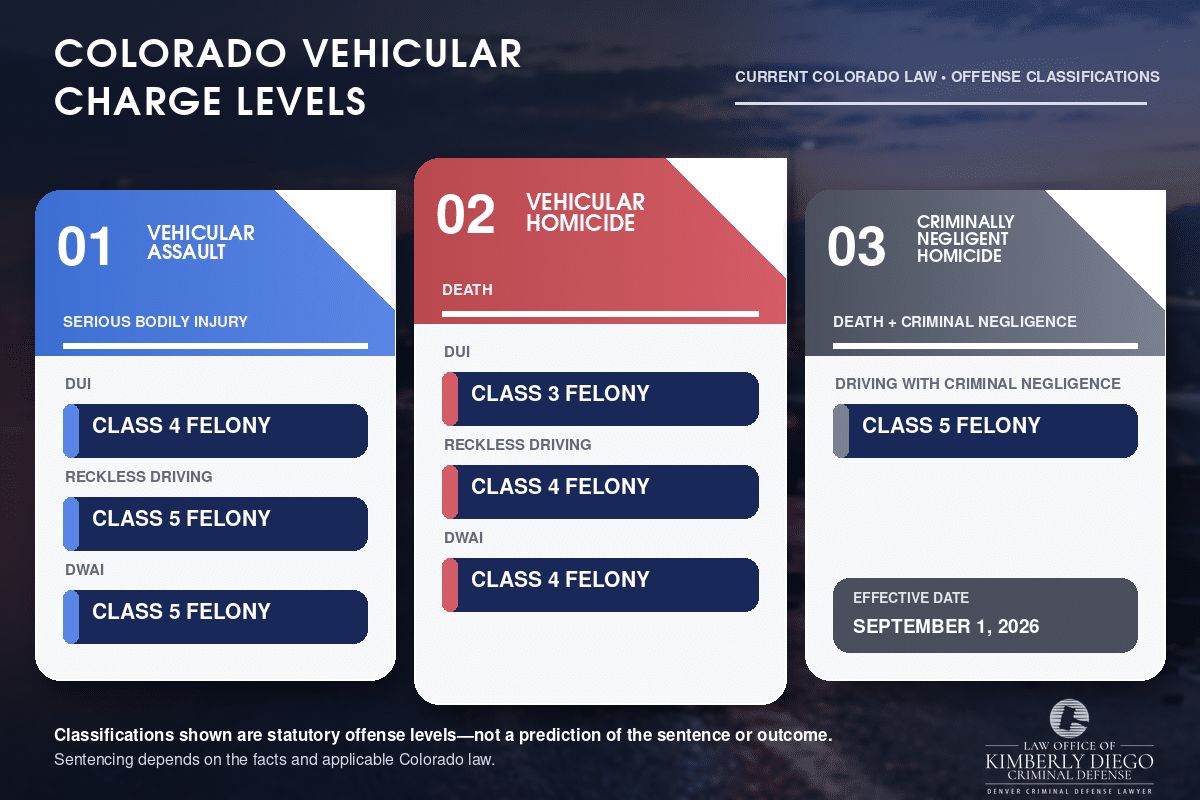
- Vehicular assault based on DUI is a class 4 felony.
- Vehicular assault based on reckless driving is a class 5 felony.
- Vehicular assault based on DWAI is a class 5 felony.
The DUI version is a strict-liability offense. This means prosecutors do not have to prove that the driver intended to injure anyone or acted with a separate culpable mental state. They must still prove operation, DUI, serious bodily injury, and proximate causation beyond a reasonable doubt.
What Must Prosecutors Prove in a Colorado Vehicular Homicide Case?
Vehicular homicide under Colorado Revised Statutes § 18-3-106 follows a similar structure, but the alleged result is death rather than serious bodily injury. DUI vehicular homicide is a class 3 felony and a strict-liability offense. Vehicular homicide based on reckless driving or DWAI is a class 4 felony.
Strict liability does not make causation automatic. Even when chemical testing suggests impairment, the prosecution must still prove that the impaired driving was the proximate cause of the death. Depending on the evidence, a medical event, another driver’s conduct, a mechanical failure, road design, weather, or a later event may become important.
What Are the Possible Penalties?
For Colorado felony offenses committed on or after July 1, 2020, the ordinary presumptive sentencing ranges are:
- Class 3 felony: Four to 12 years in prison, followed by three years of mandatory parole.
- Class 4 felony: Two to six years in prison, followed by three years of mandatory parole.
- Class 5 felony: One to three years in prison, followed by two years of mandatory parole.
These are presumptive ranges, not a prediction of a particular sentence. Aggravating or mitigating circumstances, multiple counts, consecutive-sentence rules, prior convictions, plea negotiations, and other statutory provisions may change the exposure.
A conviction can also lead to driver’s-license consequences, restitution, employment and insurance problems, and long-term effects from a felony record.
How Long Does Colorado Have to File Charges?
Colorado generally allows five years to begin a prosecution for vehicular homicide. The period increases to 10 years when vehicular homicide and leaving the scene of a crash resulting in death are alleged as part of the same criminal episode in the same charging document.
Vehicular assault ordinarily falls under the three-year limitation period for other felonies. Tolling rules and the specific charges can affect the calculation, so evaluate the filing deadline using the actual case record.
What Evidence Matters After a Serious Crash?
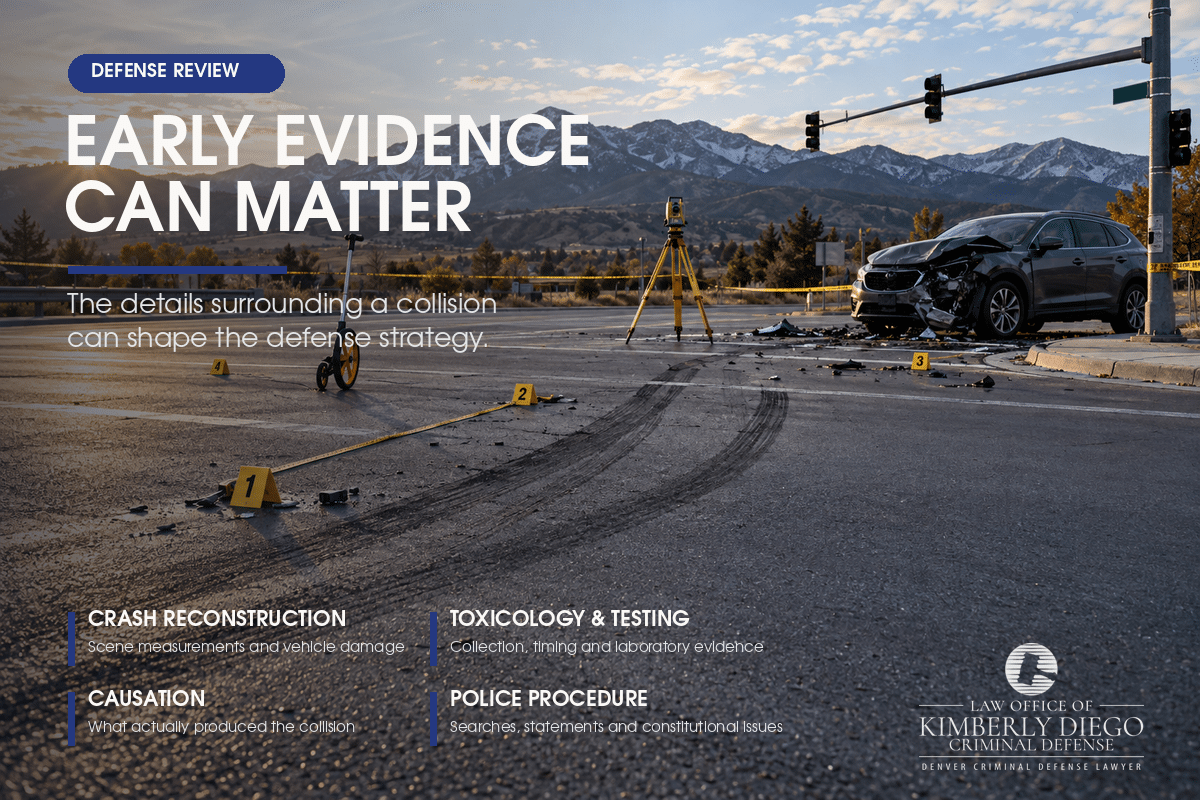
The police report is only the starting point. A defense investigation may review photographs, body-camera footage, dispatch records, traffic or business video, vehicle damage, event-data-recorder information, phone records, road conditions, sight lines, witness accounts, medical records, and the crash-reconstruction expert’s methodology.
Toxicology evidence has its own timeline. The interval between driving and testing, medical treatment before the draw, the collection kit, storage conditions, chain of custody, laboratory procedures, measurement uncertainty, and whether the reported substance actually explains the driver’s behavior can all matter.
For a broader discussion of alcohol and drug allegations, visit the firm’s Colorado DUI defense page.
How Are Alcohol and THC Results Used?
Colorado’s vehicular assault and vehicular homicide statutes assign different evidentiary effects to alcohol results obtained at the time of the alleged offense or within a reasonable time afterward:
- A BAC of 0.05 or less creates a presumption that the defendant was not under the influence of alcohol.
- A BAC above 0.05 but below 0.08 may be considered with other competent evidence when deciding whether the defendant was under the influence.
- A BAC of 0.08 or more permits—but does not require—an inference that the defendant was under the influence.
A whole-blood delta-9 THC result of five nanograms or more per milliliter likewise creates a permissible inference of drug impairment. It is not a conclusive rule. The prosecution and defense may still present other competent evidence of impairment, and the result’s reliability and meaning remain important.
The Colorado Department of Transportation’s impaired-driving resources provide general public information, but the criminal statutes and case-specific evidence control the legal analysis.
Can a Conscious Driver Refuse a Blood Draw?
In People v. Tarr, 2024 CO 37, the Colorado Supreme Court held that a conscious driver may revoke statutory consent to a blood draw. When the driver unequivocally withdrew consent, officers should have obtained a warrant unless another recognized exception to the warrant requirement applied. The court sent the case back for further consideration of the evidence’s admissibility.
That ruling does not erase Colorado’s testing laws or make refusal consequence-free. A refusal can trigger driver’s-license revocation, and police may seek a warrant or rely on another legally recognized exception when the facts support it. Whether a sample was lawfully obtained—and what remedy applies if it was not—depends on the circumstances.
What Defense Strategies May Apply?
Build a defense around the elements and evidence rather than a generic theory. Depending on the case, the investigation may focus on one or more of the following:
- Causation: Whether the charged driving, rather than another event, was the proximate cause of the injury or death.
- Crash reconstruction: Speed calculations, visibility, perception-response time, road geometry, vehicle data, mechanical condition, and the assumptions behind an expert opinion.
- Impairment and toxicology: Test timing, collection and handling, laboratory procedures, prescription or medical explanations, tolerance, and whether the result matches the observed driving.
- Search and seizure: Whether officers had lawful authority to conduct a blood draw, search a phone, search a vehicle, or collect other evidence.
- Mental state and charge level: Whether the evidence proves reckless driving, criminal negligence, simple carelessness, or none of those standards.
- Statements and witnesses: Whether questioning respected constitutional rights and whether witness accounts are consistent with the physical evidence.
Causation is often the dividing line. An intervening cause may break the legal chain when it is independent and unforeseeable, but a victim’s ordinary negligence generally does not do so by itself. Read more about the intervening-causation defense in Colorado vehicular cases.
How Did Colorado’s Criminally Negligent Homicide Law Change?
For offenses committed on or after September 1, 2026, Colorado Revised Statutes § 18-3-105 expressly states that a person commits criminally negligent homicide by operating or driving a motor vehicle with criminal negligence when that conduct proximately causes another person’s death. Criminally negligent homicide is a class 5 felony.
The same legislation repealed the former class 1 misdemeanor traffic provision for careless driving causing death.
The amendment does not make every fatal crash a felony. Colorado defines criminal negligence as a gross deviation from the care a reasonable person would exercise, involving a failure to perceive a substantial and unjustifiable risk. The prosecution must prove that mental state and proximate causation.
The distinction among carelessness, criminal negligence, and recklessness can therefore be central to the charging decision and defense strategy.
What Should You Do if You Are Under Investigation?
A person can become the focus of a serious-crash investigation before charges are filed. Do not assume that an invitation to provide a statement is informal or that investigators have already reached a final conclusion.
Preserve relevant documents, photographs, communications, location data, and vehicle information, but do not alter, delete, or manufacture evidence. Avoid discussing the incident on social media.
Before agreeing to an interview, consent search, or informal meeting, consider obtaining legal advice. The firm’s criminal investigation FAQs explain why pre-filing representation may matter even when no arrest has occurred.
Speak With a Denver Vehicular Homicide Defense Lawyer
Attorney Kimberly Diego provides direct, individualized representation in Colorado criminal cases. She can review the crash report, toxicology records, witness statements, video, vehicle data, and reconstruction evidence, then identify where the prosecution’s theory may be incomplete or unsupported.
If you or a family member is facing a vehicular assault or vehicular homicide investigation or charge, contact the Law Office of Kimberly Diego or call 720-257-5346 to request a free 45-minute consultation. The sooner the defense can identify and preserve time-sensitive evidence, the more complete the case review can be.