

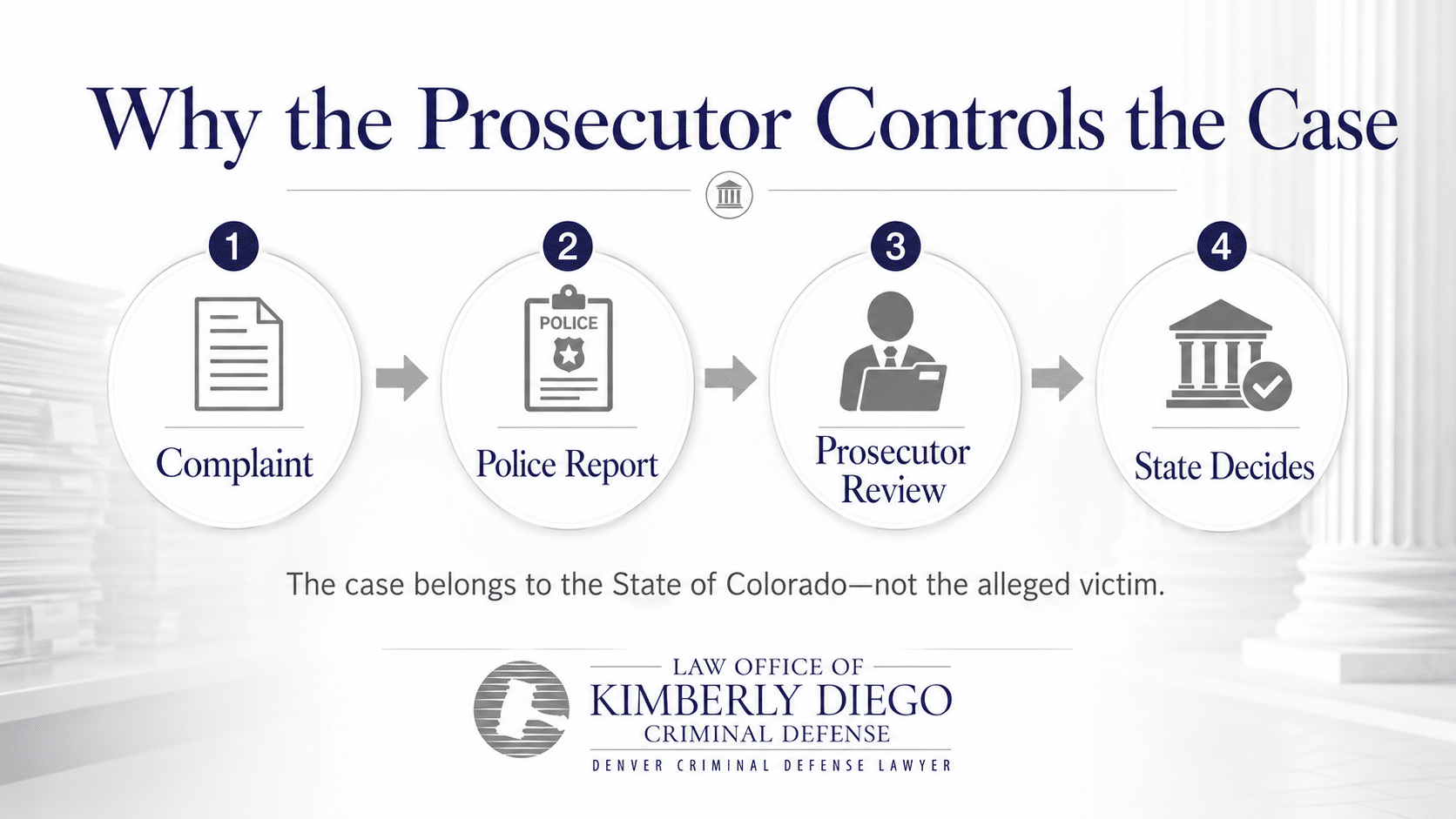
If your partner called the police during an argument and now wants the case dropped, you may assume the two of you can simply explain that to the court and move on. In Colorado, domestic violence cases do not work that way. Once police make an arrest or prosecutors file charges, the case belongs to the state, not the person who made the original report.
That means the alleged victim cannot personally drop the charges, cancel the case, or ignore a mandatory protection order just because they changed their mind. Prosecutors may consider what the alleged victim wants, but they can still move forward using 911 recordings, officer observations, body camera footage, photographs, witness statements, or other evidence.
At the Law Office of Kimberly Diego Criminal Defense, we help people in Denver and throughout Colorado understand what happens after a domestic violence arrest, what restrictions may apply, and how to begin challenging the case before early decisions create lasting consequences.
Why the Alleged Victim Cannot Drop the Charges
Once the state files a criminal case, the district attorney controls whether it proceeds or is dismissed. A complaining witness can tell the prosecutor what they want, but their wishes do not bind that decision.
Part of the reason comes from how Colorado law defines domestic violence. Under Colorado Revised Statutes § 18-6-800.3, domestic violence includes an act or threatened act of violence against a person with whom the accused is or has been involved in an intimate relationship. It can also include certain crimes against a person, property, or an animal when used as a method of coercion, control, punishment, intimidation, or revenge.
That definition is not a standalone criminal charge. Instead, domestic violence is a designation attached to an underlying offense. Because the underlying offense is prosecuted by the state, the charge belongs to the state, not to the person who called 911.
Domestic Violence Is a Sentence Enhancer, Not a Standalone Charge
Many people are surprised to learn there is no single Colorado crime called domestic violence. Instead, the phrase works as a sentence enhancer or designation that prosecutors attach to an underlying charge when the alleged facts involve an intimate relationship. Depending on what happened, that underlying charge might be:
- Assault, for allegedly causing bodily injury.
- Harassment, for unwanted contact, calls, messages, or other conduct.
- Menacing, for allegedly placing someone in fear of serious harm.
- False imprisonment, for allegedly blocking someone from leaving.
- Criminal mischief, for a broken phone, door, vehicle, or other property.
The domestic violence designation travels with the case and can add consequences, including a required treatment evaluation after a conviction. Because each underlying offense is treated as a crime against the state, only the state can decide whether to dismiss, reduce, or continue prosecuting it. This is also why Colorado domestic violence charges can reach far beyond a single act of physical harm.
Why Colorado Requires a Mandatory Arrest in Domestic Violence Cases
In many cases, the arrest is not simply a matter of the alleged victim asking for someone to be taken to jail. Colorado law requires an arrest when a peace officer determines that there is probable cause to believe a domestic violence offense occurred. Under Colorado Revised Statutes § 18-6-803.6, the officer must arrest the suspected person without undue delay when the statute applies.
This mandatory arrest rule is one reason domestic violence cases can begin even when both people have already started to calm down, or the person who called police no longer wants an arrest. The officer still has to evaluate probable cause, but once that threshold is met, the decision is no longer controlled by the alleged victim’s preference.
How a Mandatory Protection Order Works in Colorado
Anyone charged with a crime under Colorado’s criminal code is placed under a mandatory protection order at the first court appearance. Under Colorado Revised Statutes § 18-1-1001, that order remains in effect until final disposition of the case.
In a domestic violence case, the protection order often limits or bars contact with the alleged victim. It may also require the accused person to move out of a shared home, avoid certain locations, surrender firearms, comply with sobriety conditions, or follow other court-ordered restrictions.
Families are sometimes stunned to learn that they cannot legally speak while the case is pending, even if they share children, housing, bills, or a lease. A Denver criminal defense attorney can ask the court to modify the terms, but the order does not disappear simply because both people want contact.
What Happens If the Alleged Victim Recants
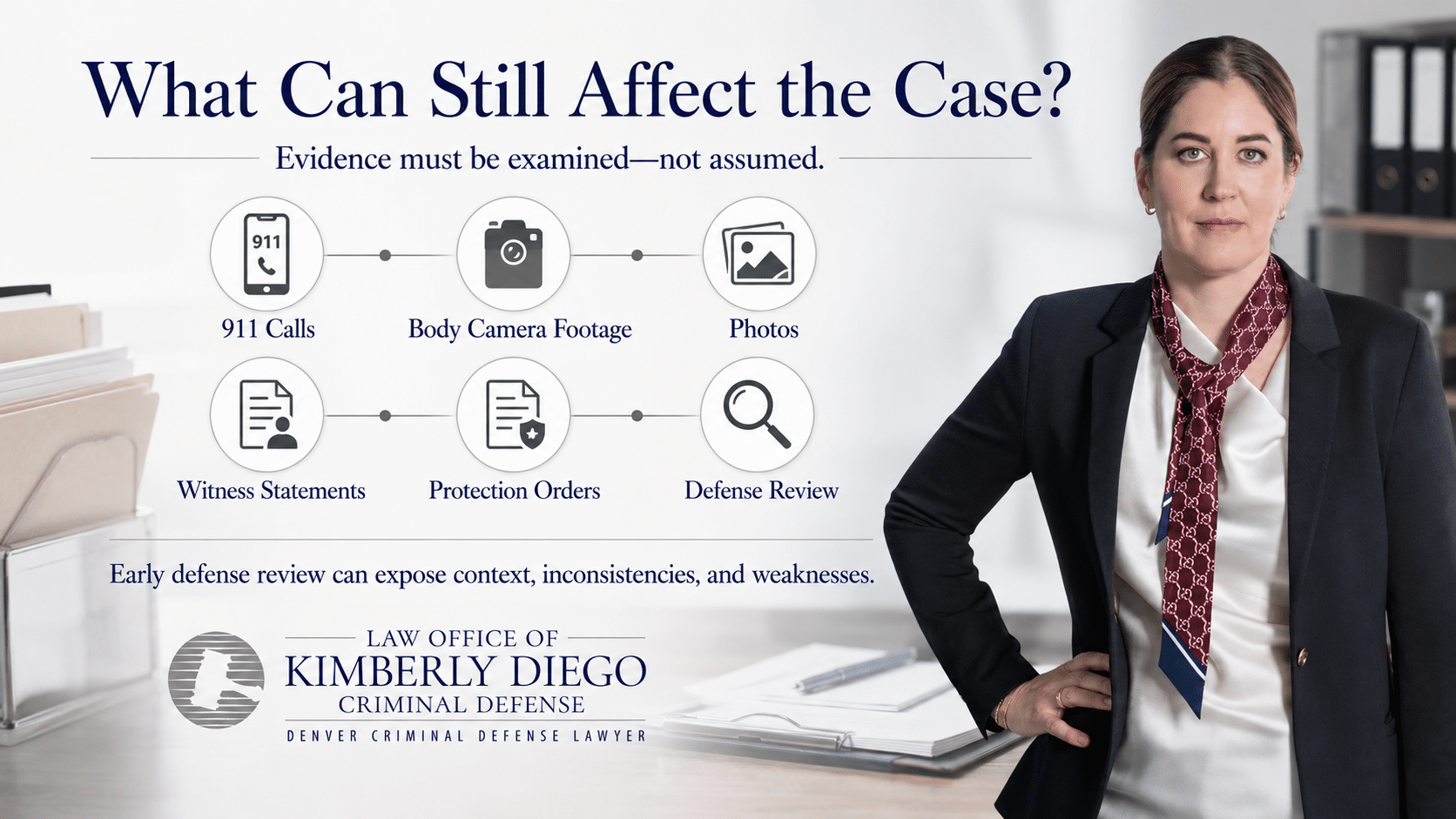
Prosecutors weigh an alleged victim’s wishes, but they are not required to follow them. If the person who reported the incident recants, changes their story, or refuses to testify, the state may still try to move forward using other evidence, such as:
- The recorded 911 call.
- Body camera footage from responding officers.
- Photographs of injuries or damaged property.
- Statements made to officers at the scene.
- Medical records or witness statements.
- Text messages, voicemails, or other digital evidence.
Cases built on false domestic violence accusations or weak evidence can become harder for the prosecution to prove under close scrutiny. However, the prosecutor still controls the timing and decision-making process. Doing nothing is risky because the case can continue with or without the alleged victim’s cooperation.
Frequently Asked Questions About Dropping Domestic Violence Charges in Colorado
Can the alleged victim drop domestic violence charges in Colorado?
No. Once a domestic violence case is filed in Colorado, the decision to continue or dismiss the case belongs to the prosecutor, not the alleged victim. The alleged victim can share their wishes with the district attorney, but they cannot personally drop the criminal charge.
Can a Colorado domestic violence case continue if the alleged victim recants?
Yes. A recantation may affect the strength of the case, but it does not automatically end it. Prosecutors may still rely on 911 calls, body camera footage, photographs, statements made at the scene, medical records, damaged property, or other evidence.
Can the no-contact order be lifted if both parties want to be in contact?
Not automatically. A mandatory protection order remains in place unless the court modifies or removes it. A defense lawyer can ask the judge to modify the order, but the accused must follow the existing terms until the court changes them.
You Cannot Drop the Charges, but a Denver Domestic Violence Lawyer Can Help
You may not be able to make a Colorado domestic violence case disappear simply because your partner wants the charges dropped, but that does not mean the outcome is already decided. The prosecution still has to prove the underlying charge, and the defense may challenge weak evidence, inconsistent statements, unlawful police assumptions, or a lack of probable cause.
Early action matters. A domestic violence case can immediately affect where you live, whether you can speak with your partner, your ability to see your children, your job, your record, and your future. The sooner a defense lawyer reviews the police reports, 911 call, body camera footage, photographs, and witness statements, the sooner the defense can identify problems with the state’s case.
If you are facing domestic violence allegations in Denver or anywhere in Colorado, the Law Office of Kimberly Diego Criminal Defense can help you understand the charges, the protection order, and your defense options. Contact our Denver domestic violence defense team today for a confidential consultation.