

A preliminary hearing in Colorado is a limited court proceeding available in certain felony cases. The judge does not decide whether the accused is guilty. Instead, the prosecution must show probable cause to believe that the charged offense occurred and that the accused committed it. Although that is a much lower standard than proof beyond a reasonable doubt, the hearing can give a Denver criminal defense lawyer an early opportunity to challenge weak allegations, question the prosecution’s evidence, and better understand the theory of the case.
Not every person charged with a crime is entitled to a preliminary hearing, and the deadline to request one can be short. Whether the hearing is available depends on the level and type of felony charge, how the case was filed, and, in some cases, whether the accused remains in custody.
What Does a Colorado Preliminary Hearing Decide?
The hearing addresses one narrow question: whether there is probable cause to believe the charged offense was committed by the accused. It is not a trial, and the judge does not decide guilt, innocence, or whether the prosecution can prove the case beyond a reasonable doubt.
Under Colorado Rule of Criminal Procedure 5, the prosecutor bears the burden of establishing probable cause. The defense may cross-examine the prosecution’s witnesses and may introduce evidence. The judge may also relax the ordinary rules of evidence, allowing the prosecution to rely on evidence that would receive closer scrutiny at trial.
Because the probable-cause standard is low, a judge can allow the case to continue even when important questions remain. A decision to bind a charge over is not a finding of guilt.
Do You Automatically Get a Preliminary Hearing in Colorado?
No. The right depends primarily on the felony classification and the circumstances of the charge:
- Class 1, 2, and 3 felonies: A person accused of a felony may demand and receive a preliminary hearing.
- Class 4, 5, and 6 felonies involving mandatory sentencing, a crime of violence, or a qualifying sexual offense: A person accused by felony complaint may also demand and receive a preliminary hearing.
- Other class 4, 5, and 6 felonies: A person who is not otherwise entitled to the hearing may request one while in custody on that offense. The hearing may be vacated if the person is released before it occurs.
- Misdemeanors and petty offenses: There is no right to a preliminary hearing under this felony procedure.
A person charged with a class 4, 5, or 6 felony who does not qualify for a preliminary hearing generally participates in a dispositional hearing unless that hearing is waived. The dispositional hearing gives the parties an opportunity to evaluate the case and discuss a possible resolution.
Because classification matters, it helps to understand the difference between a felony and a misdemeanor in Colorado and to have the charging document reviewed carefully.
How Soon Must a Preliminary Hearing Be Requested?
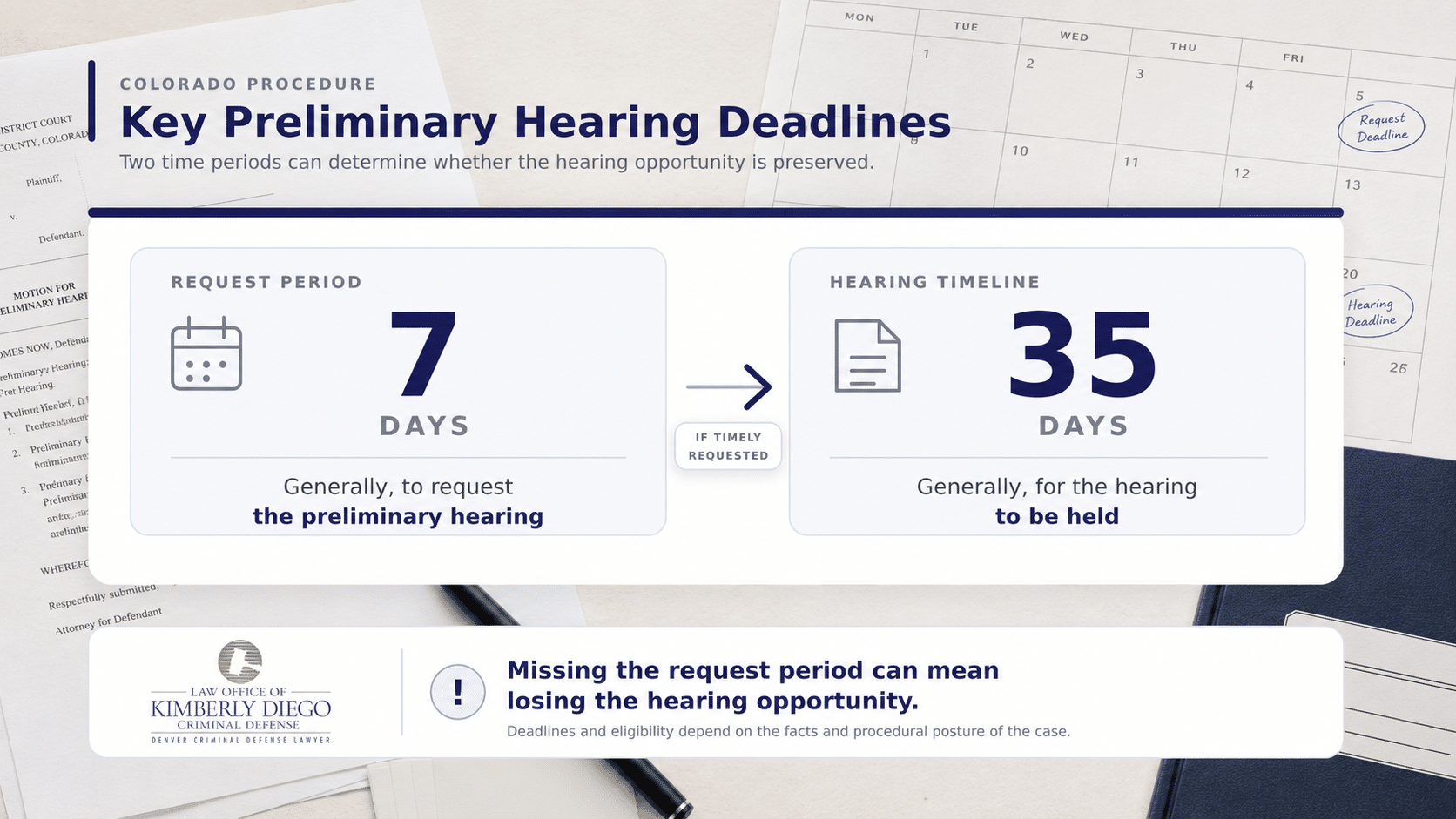
In a county-court felony complaint, either side generally must request the preliminary hearing within seven days after the accused is brought before the court for or following the filing of the complaint. Once requested and set, the hearing generally must be held within 35 days unless the court finds good cause for a continuance.
Missing the request period can result in the case being bound over without the hearing. Procedures can differ when the prosecution files a direct information in district court, so the charging document and court history should be reviewed promptly.
A preliminary hearing is also different from the earlier bail or bond hearing, which focuses on release from custody and the conditions imposed while the case is pending.
What Happens During the Hearing?
The prosecution presents testimony or other evidence intended to establish probable cause. In some cases, an officer may summarize the investigation rather than every witness appearing personally. The defense can cross-examine the witnesses called by the prosecution and may present evidence of its own.
The accused is not called upon to enter a plea at this hearing, and the defense need not prove innocence. Whether to present evidence or testimony is a strategic decision because showing too much of the defense too early can create risks. The scope of questioning is also narrower than at trial because the hearing is focused on probable cause rather than full discovery.
Even with those limits, sworn testimony and the hearing record can preserve details that may matter later. Statements made at the hearing can help counsel identify inconsistencies, evaluate a witness’s account, and prepare for later motions, negotiations, or trial.
Why Can a Preliminary Hearing Matter to the Defense?
A preliminary hearing is not valuable only when it results in dismissal. Depending on the case, defense counsel may use the hearing to:
- Challenge whether the prosecution has evidence supporting every required element of a charge.
- Question identification evidence, witness accounts, timelines, or the connection between the accused and the alleged conduct.
- Clarify which facts and witnesses the prosecution is relying on.
- Preserve sworn testimony that can be compared with later statements.
- Evaluate how the evidence may affect motions, negotiations, and trial strategy.
The best approach depends on the evidence and the larger defense strategy. In some cases, targeted cross-examination is useful. In others, limiting what the prosecution learns about the defense may be more important.
What Happens After a Colorado Preliminary Hearing?
If the judge finds probable cause, the eligible felony counts are bound over to the appropriate trial court, and the case continues. The ruling means only that the prosecution met the preliminary standard; it does not mean the charge has been proven.
If the judge finds no probable cause as to one or more counts, the court must dismiss those counts from the felony complaint. That ruling can be significant, but it may not always end the prosecution. Colorado procedure can allow the prosecutor to appeal the ruling, file a direct information in district court, or present the matter to a grand jury, depending on the circumstances.
Whatever the immediate result, the hearing can provide useful information about the strength and direction of the case. That information can shape the defense well beyond the hearing itself.
Frequently Asked Questions About Colorado Preliminary Hearings
Can charges be dismissed at a preliminary hearing in Colorado?
Yes. If the judge finds no probable cause for one or more counts in the felony complaint, those counts must be dismissed. The prosecutor may still have limited procedural options, including an appeal, direct filing in district court, or presentation to a grand jury.
Does the accused have to testify at a preliminary hearing?
No. The prosecution carries the burden of establishing probable cause, and the accused is not required to prove innocence. Whether the defense should present testimony or other evidence is a case-specific strategic decision.
What happens if a person does not qualify for a preliminary hearing?
A person charged with a class 4, 5, or 6 felony who is not entitled to a preliminary hearing generally participates in a dispositional hearing unless it is waived. That hearing focuses on case evaluation and possible resolution.
Prepare Early With a Denver Criminal Defense Lawyer
A preliminary hearing can affect how a felony case proceeds, but the opportunity is limited, and the deadline to request one can come quickly. Early review gives defense counsel time to examine the charging documents, identify the issues that matter at probable cause, and decide how much of the defense strategy to reveal.
At the Law Office of Kimberly Diego, we prepare for preliminary hearings with close attention to the evidence, the applicable charge, and the larger strategy for the case. To discuss a Colorado felony charge, contact us online or call (720) 257-5346 for a free consultation.