

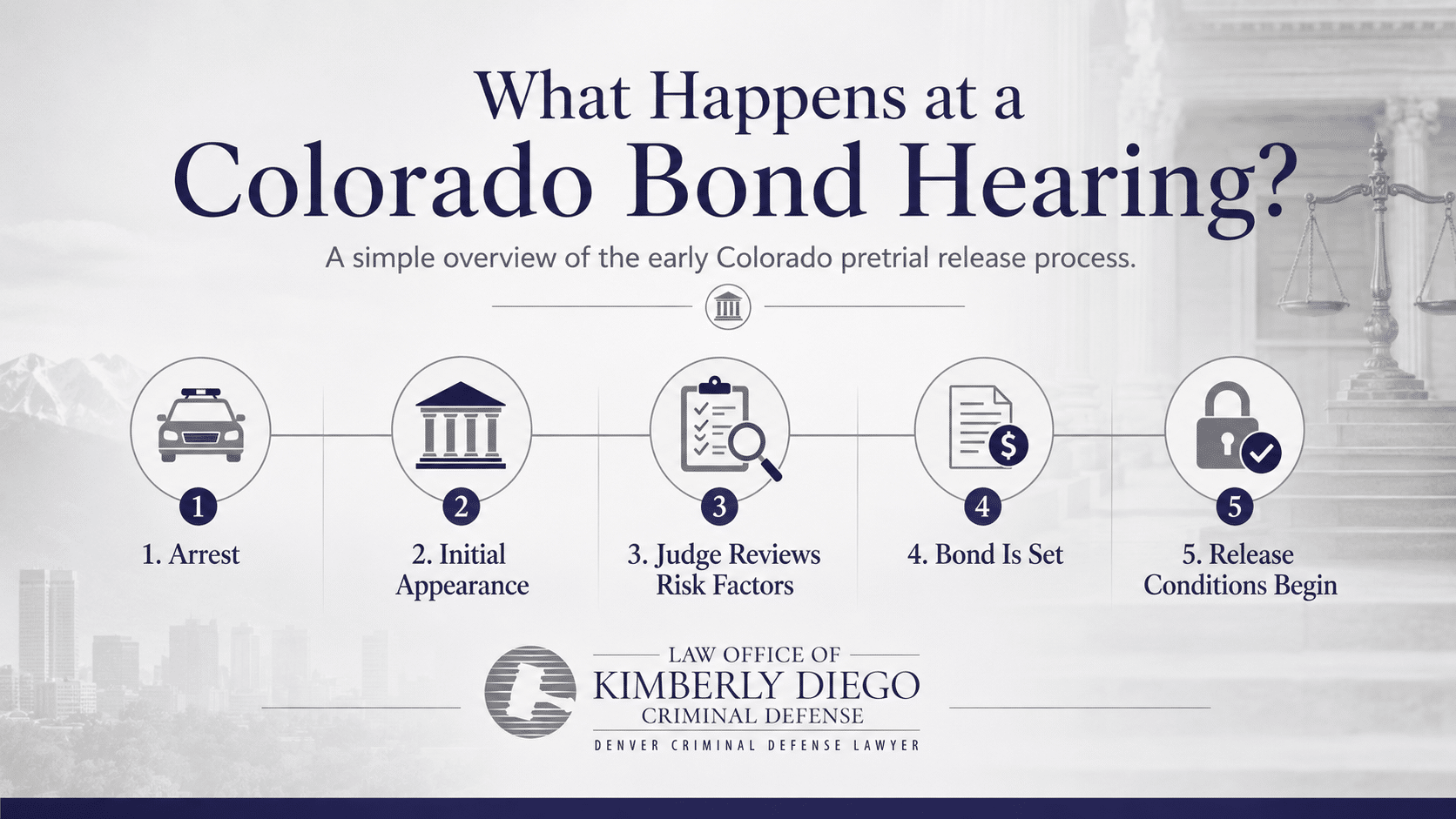
A bail or bond hearing in Colorado is one of the first major court appearances after a criminal arrest. It determines whether a person will remain in custody while their case moves forward or be released under specific conditions. Although it happens early in the process, the decisions made at this stage can influence the entire direction of the case.
In most situations, this hearing occurs within hours or days of arrest. The judge is not deciding guilt. Instead, the focus is on whether the person should be released and what conditions are necessary to ensure they return to court and do not pose a risk to public safety.
The Legal Foundation for Bail and Release in Colorado
Colorado law generally presumes that individuals are eligible for release before trial, with limited exceptions for the most serious offenses. The court uses a combination of constitutional principles and statutory rules to guide these decisions, including factors such as the severity of the charge, criminal history, and ties to the community.
Under Colorado Revised Statutes § 16-4-101, most offenses are considered bailable, meaning a judge must set conditions of release unless a narrow legal exception applies.
This statute forms the backbone of Colorado’s bail system and reinforces the principle that pretrial detention should not be automatic. Instead, judges are required to evaluate whether conditions such as a cash bond, a surety bond, or a personal recognizance release can reasonably ensure the defendant’s appearance in court and public safety.
What Happens During a Bail or Bond Hearing
At the hearing, the judge reviews basic case information, including the charges, arrest details, and any available background information about the defendant. The prosecution and defense may both argue whether the defendant should be released and, if so, under what conditions.
The prosecution often focuses on factors like the seriousness of the allegations, prior criminal history, or perceived flight risk. Our Colorado criminal defense attorney at the Law Office of Kimberly Diego can present information, such as employment, residence history, family ties, or a lack of prior record, to support release on a lower or unsecured bond.
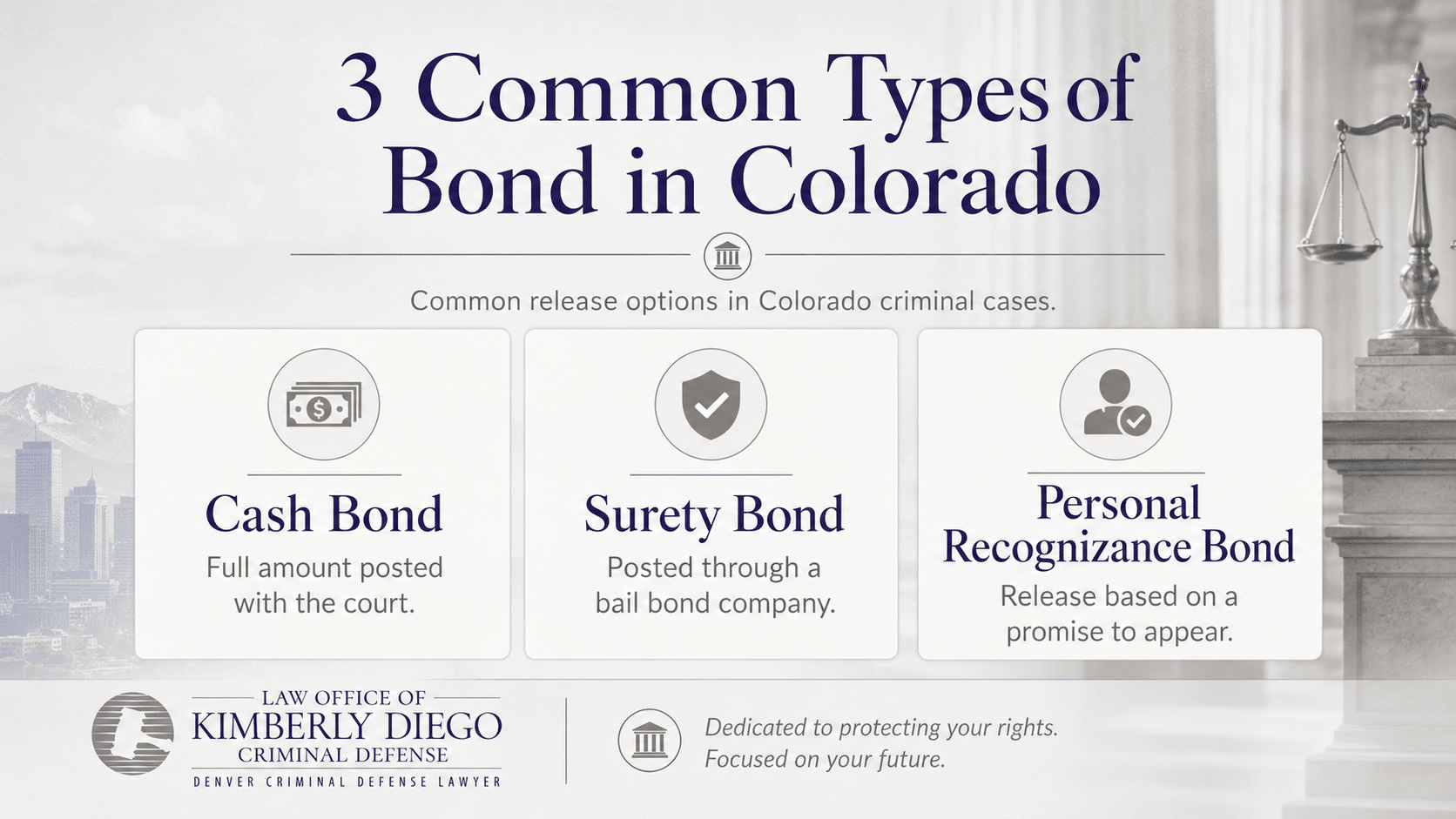
The judge then determines the type and amount of bail or bond. This can include:
- Cash bond (full amount posted with the court)
- Surety bond (posted through a bail bond company)
- Personal recognizance bond (release based on a promise to appear)
In addition to financial terms, the court may impose conditions such as travel restrictions, pretrial supervision, drug or alcohol testing, or no-contact orders, depending on the nature of the case.
Factors Judges Consider When Setting Bond
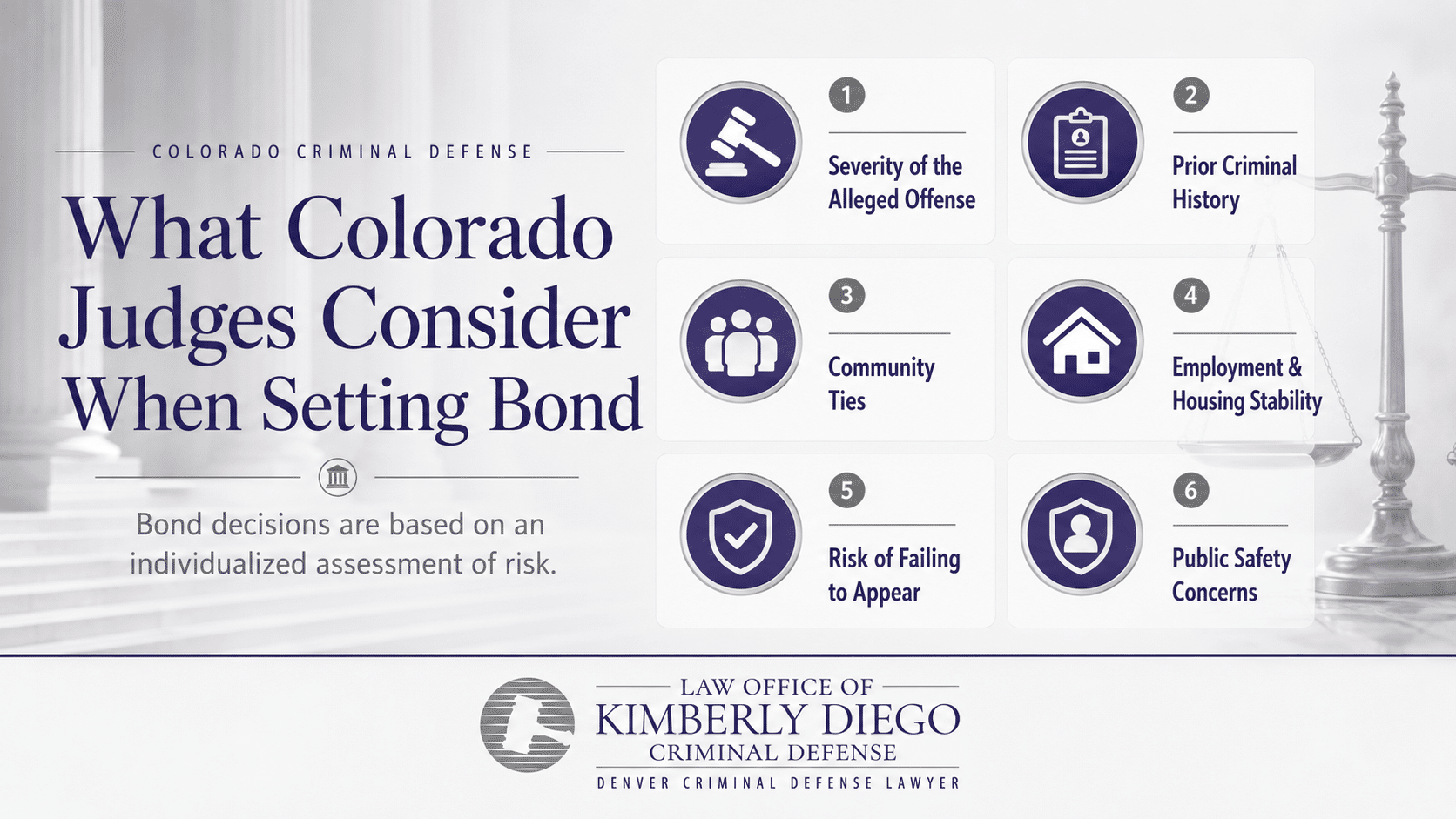
Bond decisions in Colorado are based on an individualized assessment of risk rather than punishment. Judges evaluate multiple factors together before deciding whether to release a defendant and, if so, under what conditions. These include:
- Severity of the alleged offense: Judges consider how serious the charges are and the level of harm or risk involved in the alleged conduct.
- Prior criminal history: A defendant’s past record, including prior convictions or missed court appearances, is reviewed to assess reliability and compliance.
- Strength of community ties: Family connections, length of residence, and local support systems are considered as indicators of stability.
- Employment and housing stability: Steady work history and a fixed residence are viewed as signs of structure and accountability while the case is pending.
- Risk of failing to appear in court: The court evaluates whether there is a realistic chance the defendant may not return for future hearings.
- Possible danger to the public or specific individuals: In cases involving violence, threats, or safety concerns, judges assess whether release could pose a risk to others.
These factors are weighed together rather than in isolation, meaning no single detail automatically determines the outcome. Two people charged with similar offenses can receive very different bond conditions depending on their backgrounds and the circumstances of their cases.
What Happens If Bond Conditions Are Violated
Once released, the defendant must strictly follow all court-ordered conditions. Violating those conditions can result in the bond being revoked and the person being taken back into custody. In some cases, additional criminal charges may also be filed for failure to comply with court orders.
The purpose of these conditions is not punishment but ensuring compliance with the court process. Judges have wide discretion to modify or revoke bond if they believe conditions are being ignored or if new concerns arise during the case.
Frequently Asked Questions About Colorado Bail & Bond Hearings
What is the difference between bail and bond in Colorado?
While often used interchangeably, “bail” refers to the specific dollar amount or release conditions set by the court, while “bond” is the legal vehicle used to secure that release. Under Colorado Revised Statutes § 16-4-101, you can post this bond via cash directly to the court, through a licensed surety bail bondsman, or via a personal recognizance (PR) bond, which relies on a written promise to appear.
How soon do you get a bond hearing after an arrest in Denver?
In Colorado, an individual who remains in custody is typically brought before a judge for a bond hearing within 24 to 48 hours of their arrest, excluding weekends and court holidays. This initial appearance is often referred to as advisement or a “Chief Judge Directive” hearing, in which the court formally evaluates flight risk and public safety factors to establish release terms.
Can a judge deny bail entirely in a Colorado criminal case?
Yes, but only under strict constitutional exceptions. Under the Colorado Constitution, bail may be denied for individuals charged with capital offenses, certain violent crimes, or felony offenses committed while already on bond or parole, provided the prosecution can demonstrate that “the proof is evident or the presumption great” that the defendant committed the crime.
Secure Experienced Legal Representation for Your Denver Bond Hearing
The decisions handed down during a Colorado bail hearing will directly impact your personal freedom, your ability to maintain employment, and how effectively you can participate in your own defense. Attempting to navigate the fast-paced pretrial process without aggressive legal representation can result in unnecessarily high cash requirements or restrictive supervision terms that disrupt your daily life.

At the Law Office of Kimberly Diego, we step in immediately following an arrest to advocate for fair, manageable release terms. Our defense team understands how Denver-area judges evaluate community ties and flight risks. We fight to minimize financial burdens, challenge overreaching monitoring conditions, and establish a proactive framework to protect your rights from day one.
How to Take Control of Your Defense Today:
- Step 1: Request a Free, Confidential Case Evaluation
Reach out to our legal team immediately to review the active charges and impending hearing schedules. Connect with us online or call our main line directly:
-
- Denver Office Phone: (720) 257-5346
- Step 2: Develop a Strategic Release Plan
Consult directly with defense attorney Kimberly Diego at our Denver office to compile critical evidence of local residency, employment history, and family ties to present a compelling argument to the arraignment court.
- Step 3: Build an Aggressive Pretrial Defense
Establish a sophisticated legal framework designed to counter the prosecution’s initial arguments, challenge the underlying arrest protocols, and work toward a favorable resolution or dismissal.