

Short answer: A Denver arrest does not automatically create a Colorado extreme risk protection order. However, allegations or evidence connected to the arrest can prompt an eligible person or agency to file a separate civil ERPO case. That case may move much faster than the criminal charge.
Police reports, witness accounts, alleged threats, statements about self-harm, and information about firearm access may all become relevant to an ERPO petition. The court does not need to wait for the criminal case to end, and an ERPO is not a finding that the respondent committed the charged crime.
That speed is what surprises many people. We often meet clients at our Denver office who are focused entirely on what happens after an arrest and do not realize that a separate petition may already be moving through another court process. If you own firearms and have been arrested, discuss that issue promptly with a Denver criminal defense lawyer.
How Can an Arrest Lead to an Extreme Risk Protection Order?
An arrest and an ERPO are separate proceedings. The prosecutor controls the criminal case. An ERPO begins only when a legally authorized petitioner files a sworn petition alleging that the respondent poses a significant risk of causing personal injury to themselves or another person by having, possessing, purchasing, or receiving a firearm.
The arrest itself may supply information for that petition. For example, a police officer may learn during an investigation that firearms were present, a family member may report alleged threats, or statements and conduct documented during the arrest may raise concerns about future harm. Law enforcement or another eligible petitioner can then ask the court for an ERPO without waiting for a conviction—or even for the criminal charge to be resolved.
An ERPO also differs from a personal or civil protection order. An ERPO restricts firearm access. A personal protection order generally addresses contact or physical separation. Depending on the allegations, a person may face more than one type of order at the same time.
Who Can File a Colorado ERPO Petition?
Colorado law allows several categories of petitioners to seek an ERPO:
- Family or household members;
- Law enforcement officers or agencies;
- Certain licensed health care or mental health professionals and educators who had the required direct professional relationship or interaction with the respondent, or the respondent’s child, within the previous six months;
- Qualifying co-responders who interacted with the respondent through a community response program within the previous six months; and
- Institutional petitioners, including certain health care and behavioral health facilities, school districts, charter and private schools, and colleges and universities.
Senate Bill 26-004, which took effect on April 6, 2026, added co-responders and institutional petitioners to the law. The expanded list matters after an arrest because a petition may now come from an institution or professional involved in the events, not only from police or a family member.
How Fast Can a Temporary ERPO Take Effect?
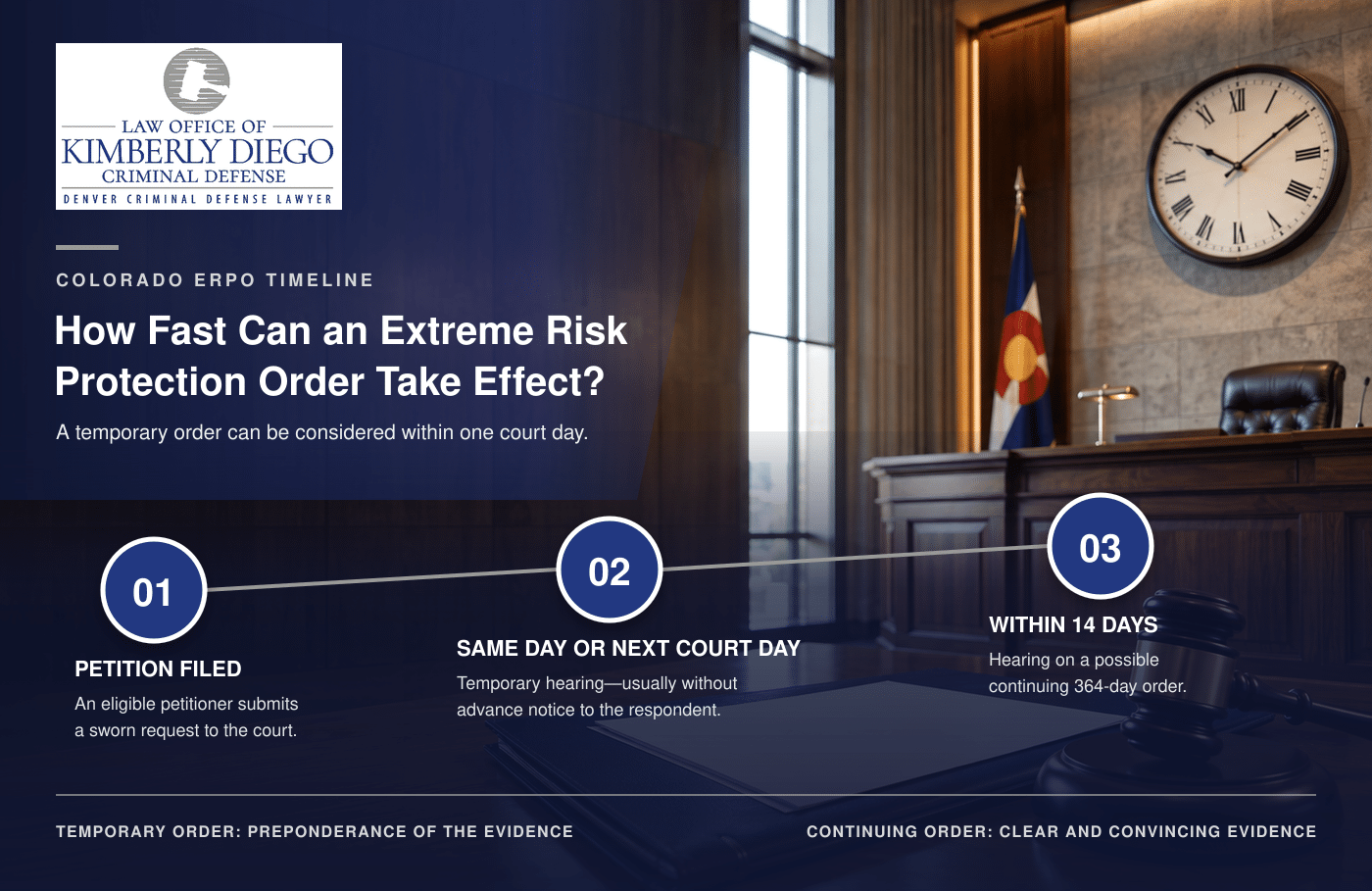
A temporary ERPO can be issued quickly. Under Colorado law, the court must hold the temporary hearing on the day the petition is filed or on the next court day. The respondent ordinarily does not receive advance notice or attend that first hearing.
At the temporary stage, the petitioner must prove by a preponderance of the evidence that the respondent poses a significant risk in the near future by having, possessing, purchasing, or receiving a firearm. If the court issues the temporary order, it schedules a second hearing no later than 14 days later.
The temporary order can require the respondent to surrender firearms in their custody, control, or possession, along with any concealed handgun permit. The Colorado Judicial Branch publishes the current ERPO instructions and court forms.
What Must a Judge Find at the Continuing ERPO Hearing?
At the second hearing, the court decides whether to issue a continuing ERPO for 364 days. The burden is higher than it was at the temporary hearing: the petitioner must establish by clear and convincing evidence that the respondent poses a significant risk of causing personal injury to themselves or another person by having, possessing, purchasing, or receiving a firearm.
The respondent is entitled to legal representation. The court appoints an attorney, although the respondent may retain counsel of their choice. Both sides may present evidence, call witnesses, and question the other side’s witnesses.
This hearing may create strategic issues when a criminal case is pending. Testimony, documents, recordings, and witness accounts may overlap with the criminal allegations. A defense that appears helpful in one courtroom can create problems in the other if the two matters are not coordinated.
What Happens to Firearms and a Concealed Handgun Permit?
While an ERPO is in effect, the respondent may not possess, control, purchase, or receive a firearm. The respondent must surrender the firearms covered by the order and any concealed handgun permit in accordance with the court’s instructions. Ignoring the order or attempting an improper transfer can create additional legal exposure.
A respondent may file one motion during a 364-day order asking the court to terminate it early. At that hearing, the respondent must prove by clear and convincing evidence that the significant risk no longer exists. The original petitioner may also request renewal before the order expires.
What Should You Do If You Are Served With an ERPO?
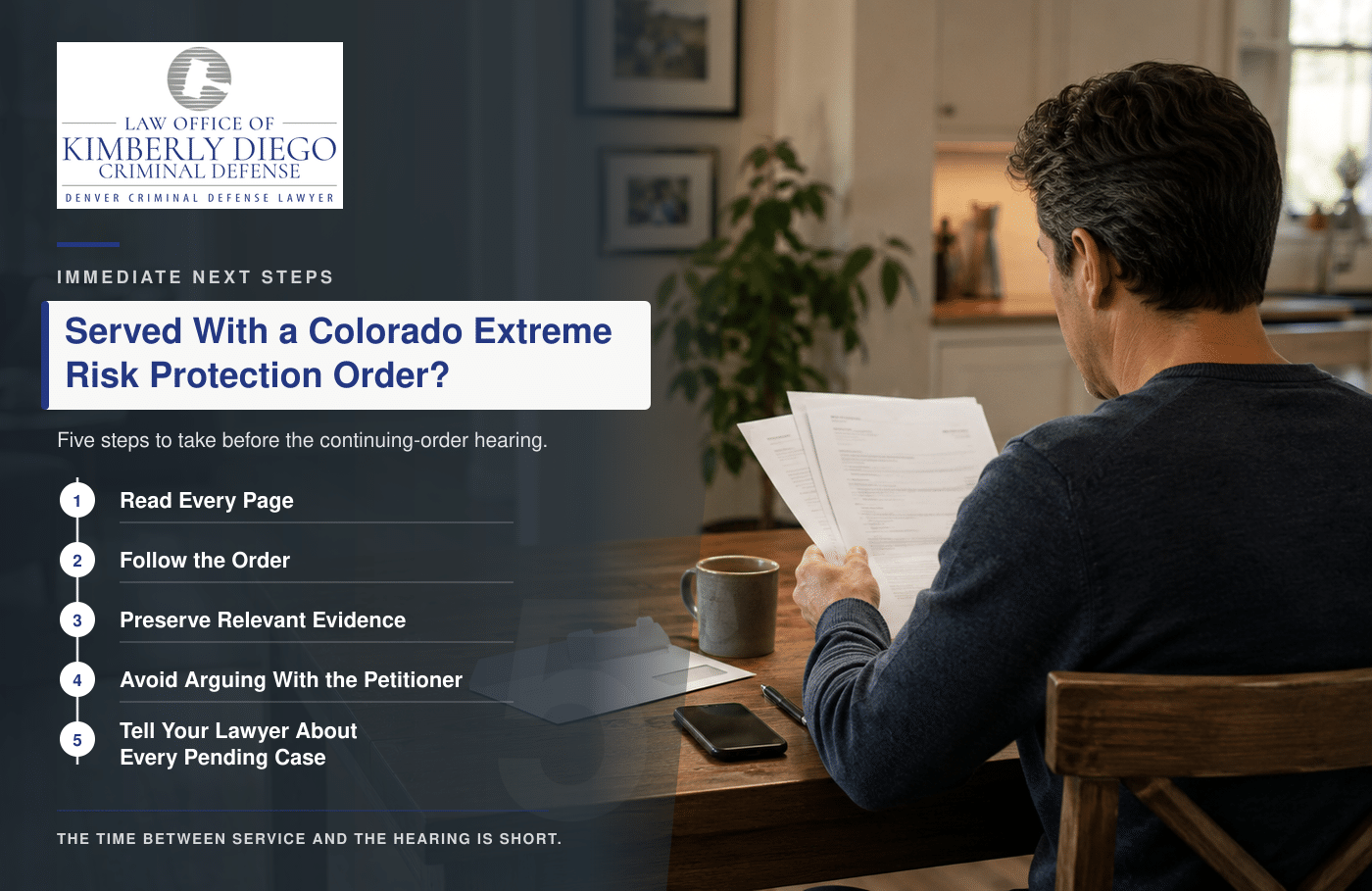
The time between service and the continuing-order hearing is short. If you receive an ERPO, take these steps promptly:
- Read every page. Confirm the hearing date, surrender instructions, and any affidavit or proof-of-compliance requirement.
- Follow the order. Do not possess, hide, retrieve, or transfer a firearm contrary to the court’s directions.
- Preserve evidence. Save relevant messages, recordings, photographs, medical or treatment records, names of witnesses, and other material that may provide context or challenge the allegations.
- Avoid arguing with the petitioner. Contact can worsen the situation and may violate a separate protection order or criminal release condition.
- Tell your lawyer about every pending case. Your ERPO response should account for the criminal charge, bond conditions, and any related protection order.
Do not assume that the criminal case must be resolved before you address the ERPO. Missing the second hearing can allow the court to decide whether to enter a 364-day order without your evidence and testimony being fully presented.
Coordinate the ERPO and Criminal Defense Early
A Colorado ERPO is civil, but its consequences are immediate, and its evidence may overlap with a criminal prosecution. The Law Office of Kimberly Diego treats the ERPO as a separate matter while making sure the hearing strategy does not undermine the defense to the underlying charge.
Denver criminal defense attorney Kimberly Diego represents people facing criminal allegations, firearm-related restrictions, and related court proceedings. To discuss an arrest and an extreme risk protection order, call 720-257-5346 or contact us online. Calls are answered 24 hours a day.