

Missing a Colorado sex offender registration deadline can expose you to a separate criminal charge. A short delay is not automatically excused, and registering late does not necessarily erase the missed deadline. At the same time, missing a deadline is not the same as a conviction. The prosecution generally must prove a knowing failure to comply, and the exact notice, deadline, jurisdiction, and surrounding facts can matter.
If you believe you missed a deadline, act promptly. Do not ignore the problem, guess what the agency requires, or provide inaccurate information to fix it. A Colorado sex offender registration attorney can help determine what requirement applied, whether a warrant or charge exists, and how to address compliance without creating avoidable problems.
What Should You Do After Missing a Registration Deadline?
Your first priority should be to prevent the situation from becoming more complicated. That does not mean rushing into a registration office without understanding what happened or making statements that may later be used against you.
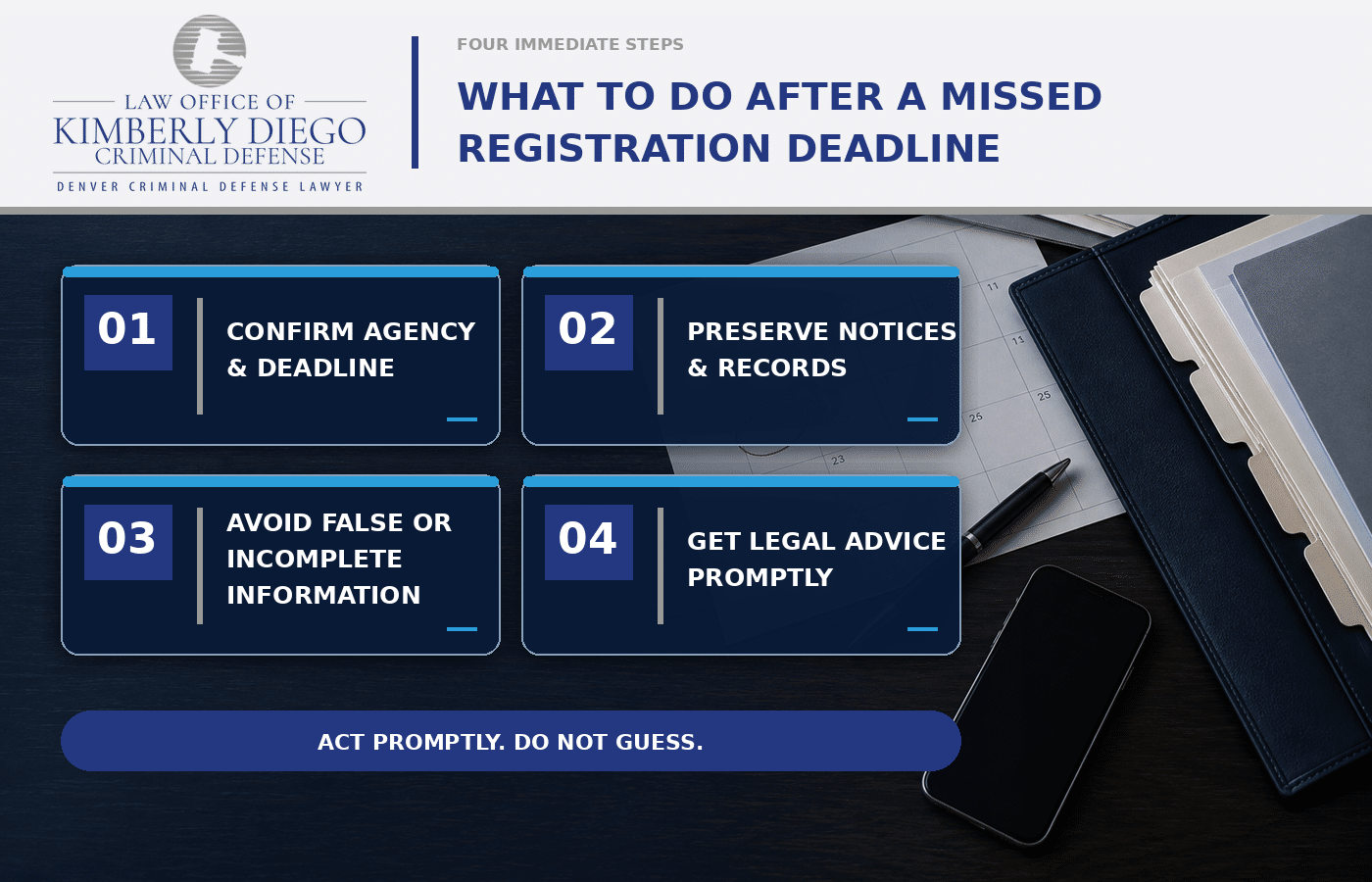
- Identify the correct registration agency. Colorado generally requires registration with the local law enforcement agency in every jurisdiction where a person resides. Inside a city or town, that is usually the police department; outside municipal limits, it is generally the county sheriff.
- Confirm the deadline and the alleged violation. Determine whether the issue involves an initial registration, birthday registration, quarterly registration, a move, an additional residence, a legal name change, or another required update.
- Preserve records. Keep notices, prior registration forms, calendars, appointment confirmations, voicemails, emails, travel records, medical records, and notes showing any effort to comply.
- Do not provide false or incomplete information. Colorado law separately treats false or incomplete registration information as a potential failure-to-register offense.
- Get legal advice and address compliance promptly. Counsel can check for a warrant or filed case, review what you were told, and help coordinate the next step. Don’t let uncertainty add delay.
Procedures differ by agency. For example, the Denver Police Department’s current registration page states that new registrations require an appointment and provides current location, hours, identification, and payment instructions. Check the responsible agency’s current directions rather than relying on an old form or someone else’s experience.
Which Colorado Registration Deadlines Can Lead to a Charge?
A failure-to-register allegation is not limited to missing the first registration. Colorado law permits a charge for failing to comply with any requirement imposed on a registrant. Depending on the person’s status and circumstances, important deadlines can include:
- Initial registration: generally within five business days after release into the community or after receiving notice of the duty to register when the person was not incarcerated.
- Release from prison without supervision: generally by the next business day.
- Annual registration: within the five-business-day period before or after the registrant’s birthday.
- Quarterly registration: required for sexually violent predators and certain other registrants, generally within five business days before or after each quarterly date.
- Moving or adding a residence: registration and cancellation requirements may apply in the old and new jurisdictions, even when the move is within Colorado.
- Moving into Colorado: generally within five business days after establishing a Colorado residence.
- Legal name changes: generally within five business days after the change.
- No fixed residence: monthly or quarterly reporting may apply, depending on the person’s normal registration schedule.
- School or employment at a postsecondary institution: additional campus-related information must be reported when the statute applies.
- Certain online identities: some registrants must report an email address, instant-messaging identity, or chat-room identity before using it.
The Colorado Bureau of Investigation’s registration guidance summarizes the statewide requirements, but the correct deadline can depend on the conviction, registration category, residence history, and notice provided. For a broader discussion of ongoing duties, see Colorado Sex Offense Registry Requirements and Consequences. This article focuses specifically on what happens after a deadline may have been missed.
Does Registering Late Prevent a Failure-to-Register Charge?
No automatic safe harbor applies simply because a person registers after the deadline. Late registration may correct the current record, but it does not necessarily eliminate criminal exposure for the earlier failure. Whether law enforcement or prosecutors pursue a case can depend on the evidence, the length and reason for the delay, prior compliance, and other circumstances.
Prompt action may still be important. It can prevent another deadline from passing, preserve a clearer record of what occurred, and support arguments about intent or mitigation. However, no one should assume that appearing late guarantees immunity or that explaining the delay informally will resolve the issue.
What Are the Penalties for Failure to Register in Colorado?
Under C.R.S. § 18-3-412.5, the level of the failure-to-register charge generally tracks the offense that created the registration duty:
- If the underlying unlawful sexual behavior was a misdemeanor, failure to register is generally a class 1 misdemeanor.
- If the underlying unlawful sexual behavior was a felony, failure to register is generally a class 6 felony.
- A second or subsequent failure-to-register offense for a person in the felony category is generally a class 5 felony.
A new charge may also create problems with probation, parole, bond, or other supervision. The actual consequences depend on the case, criminal history, registration category, and whether other allegations are involved.
What Must Prosecutors Prove?
Colorado’s model criminal jury instruction applies a knowing mental state to failure to register. In a missed-deadline case, important questions can include:
- Was the person legally required to register at that time?
- What specific deadline or reporting duty applied?
- Did the correct agency and jurisdiction receive the required information?
- What notice did the person receive about the duty and deadline?
- Did the person knowingly fail to comply?
- Do registration records, communications, or other documents support the allegation?
A missing signature on a notice is not necessarily a defense if the prosecution can prove actual notice by other evidence. Conversely, a signed form does not resolve every issue. The wording of the notice, prior instructions, agency records, and what the person understood about the relevant facts may all require close review.
What Defenses May Apply to a Missed Deadline?
No single defense fits every failure-to-register case. Depending on the evidence, the defense may dispute the deadline, the jurisdiction, the alleged residence change, the adequacy of notice, the accuracy of agency records, or whether the failure was knowing.
Colorado also recognizes a narrow affirmative defense based on uncontrollable circumstances. The defense requires proof that:
- uncontrollable circumstances prevented compliance;
- the person did not create those circumstances in reckless disregard of the registration requirement; and
- the person complied as soon as the circumstances ended.
This defense has a formal notice requirement that generally must be satisfied no later than 35 days before trial. Illness, hospitalization, detention, transportation problems, an agency closure, or another emergency may be relevant, but the facts must meet all statutory elements. Ordinary forgetfulness or registering late, by itself, is not the statutory defense.
Can a Missed Deadline Affect Registry Removal?
A missed deadline can complicate future relief, but it does not automatically make every registrant permanently ineligible to seek removal. Eligibility to discontinue registration depends on the original offense, the applicable waiting period, later convictions involving unlawful sexual behavior, and other statutory requirements. The court may also consider treatment records, victim statements, risk, and other relevant information.
There is also a separate issue involving public internet posting. Colorado law may require internet posting for an adult registrant with a felony conviction who fails to register. If the person’s information was posted only for that reason, the person may be able to petition to discontinue the internet-posting requirement after at least one year of full compliance and satisfaction of the other statutory conditions. That is different from ending the underlying duty to register.
Because these are separate forms of relief, a person considering a petition should obtain an individualized eligibility review. Learn more about Colorado sex offender registry removal.
Talk With Kimberly Diego About a Missed Registration Deadline
A missed deadline can move quickly from a compliance concern to an arrest, warrant, or new criminal case. Kimberly Diego works directly with clients facing Colorado registration allegations and can evaluate the notice, agency records, timing, and available defenses.
If you missed a deadline or believe law enforcement is investigating a registration violation, contact the Law Office of Kimberly Diego for a free consultation or call (720) 257-5346. Acting promptly can protect your options and help prevent an already serious problem from becoming more difficult.