

Colorado’s new field drug test law changes what may happen after police use a color-changing test on a suspected controlled substance. For offenses committed on or after March 26, 2026, Colorado House Bill 26-1020 limits arrests in certain low-level possession cases and requires judges to give defendants a specific warning before accepting certain drug possession pleas.
The law does not prevent police from investigating suspected drug possession, and it does not automatically dismiss a charge. It does, however, recognize that a field test is only a preliminary screening tool—not the same thing as testing performed by an accredited forensic laboratory.
If a field test influenced your arrest or drug possession charge, a Denver drug crimes attorney can examine the test, the search that produced the alleged substance, and whether police followed the new summons requirements.
What Is a Colorimetric Field Drug Test?
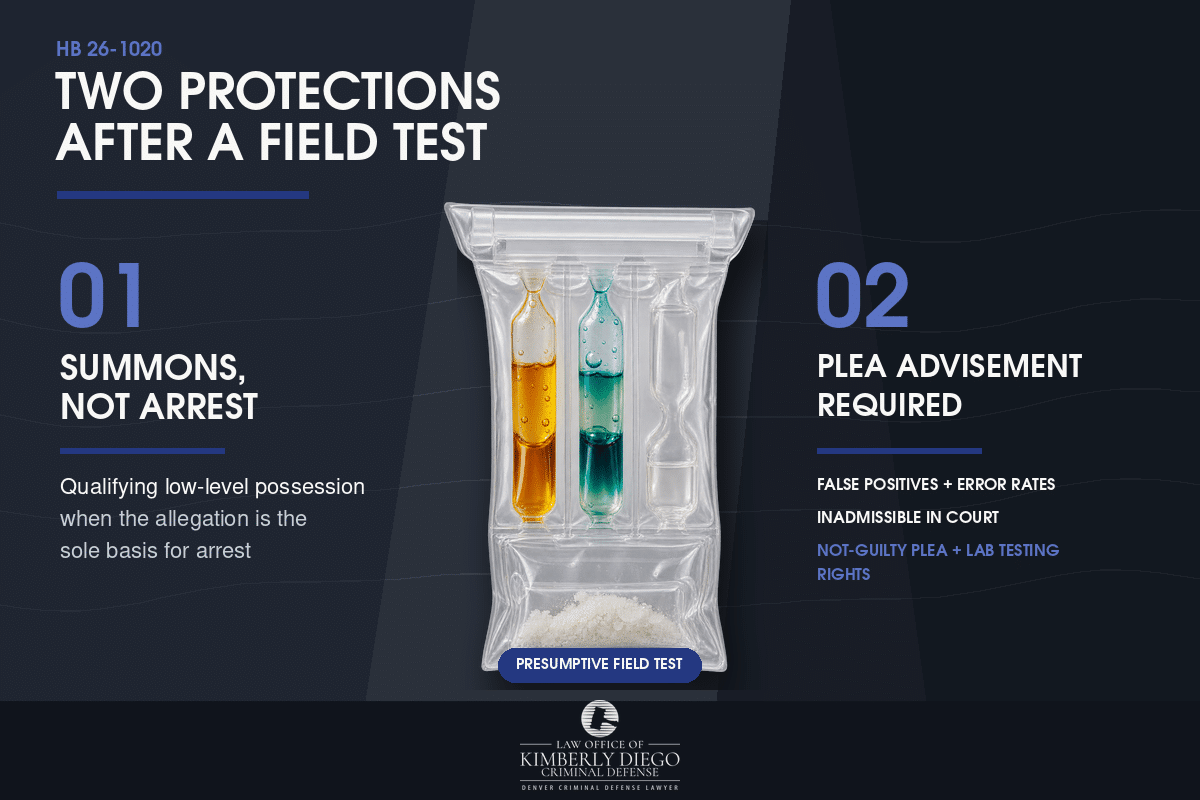
A colorimetric field drug test is a presumptive chemical screening method performed outside a forensic laboratory by someone other than a forensic chemist. An officer places a reagent in contact with an unknown substance and watches for a visible color change that may indicate the presence of a controlled substance.
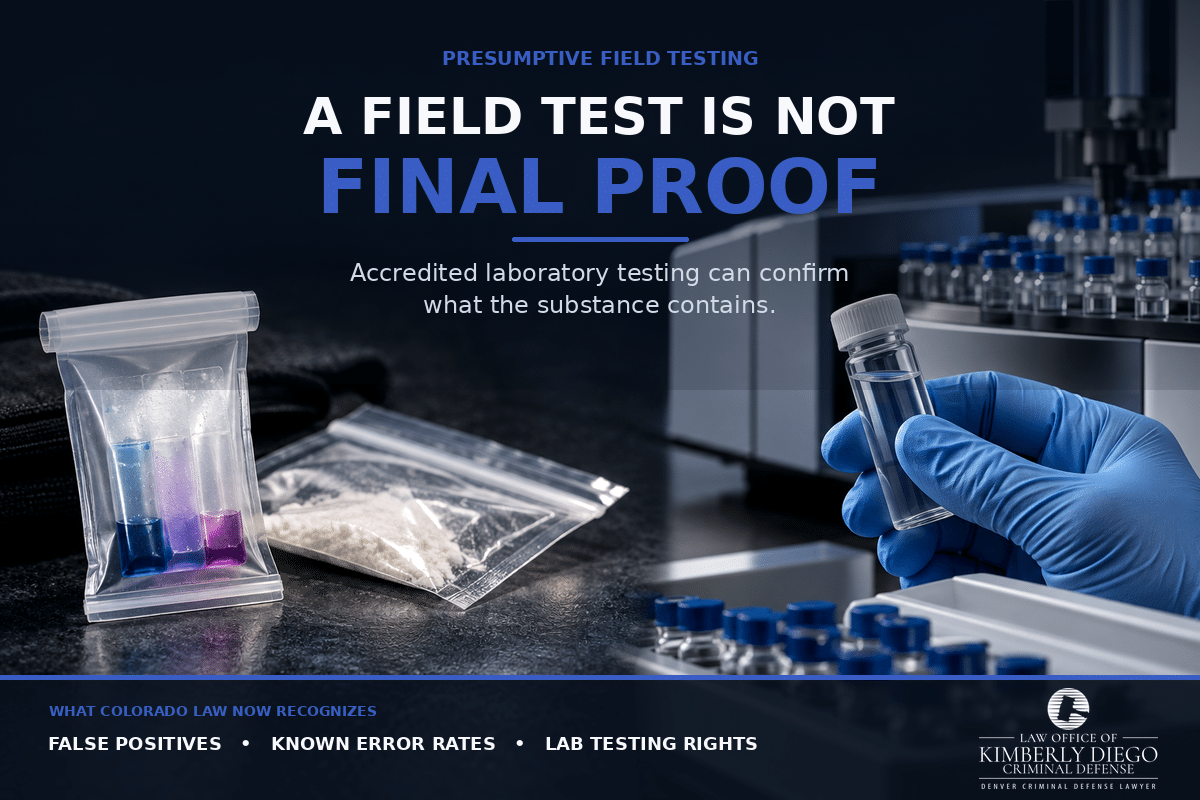
The important word is presumptive. A color change may suggest that a particular drug is present, but it does not conclusively identify the substance. A National Institute of Justice evaluation of narcotics screening tests explained that colorimetric testing cannot identify a substance to the exclusion of all others and documented false-positive results during testing.
That distinction matters when a preliminary roadside result becomes the basis for an arrest, criminal charge, or proposed guilty plea.
When Colorado Police Must Issue a Summons Instead of Making an Arrest
Under HB 26-1020, an officer generally may not arrest someone when all of the following are true:
- A colorimetric field drug test was used;
- The person is suspected only of level 1 drug misdemeanor possession or a municipal drug possession violation; and
- The qualifying possession allegation is the sole basis for the proposed arrest.
In that situation, the officer must release the person and issue a summons requiring a later court appearance.
The phrase “solely suspected” is important. The law does not prohibit an arrest when officers have another lawful basis for taking the person into custody, such as a separate alleged offense or an outstanding warrant. Whether the summons protection applies therefore depends on the complete circumstances—not merely the amount or type of suspected substance.
A Summons Does Not Mean the Drug Charge Was Dismissed
Being released with a summons is better than being taken into custody, but it does not end the case. A summons and complaint start a court process and require you to appear at the listed time and place.
Prosecutors may still pursue the possession charge, seek laboratory testing, and rely on other admissible evidence. Missing the court date can create additional problems. Anyone who receives a summons should treat it as a pending criminal matter and speak with an attorney before deciding how to respond.
What a Colorado Judge Must Explain Before Accepting a Plea
HB 26-1020 also changes the plea process. When a qualifying state or municipal possession case uses a colorimetric field drug test, the judge must provide a specific advisement before accepting a plea.
The advisement must explain that:
- Presumptive colorimetric field drug tests are subject to false-positive results;
- The tests have known error rates;
- The tests are inadmissible in court;
- The defendant has the right to plead not guilty; and
- The defendant may request drug testing by an accredited forensic laboratory.
This protection is broader than the arrest limitation. The arrest rule applies only to level 1 drug misdemeanors and municipal possession allegations. The plea advisement can apply to felony, misdemeanor, and municipal possession cases when a colorimetric test was used.
The advisement is especially important for people who might otherwise plead guilty before learning whether a laboratory has confirmed the alleged substance’s identity.
Which Colorado Drug Possession Charges Receive the Arrest Protection?
Under Colorado’s current possession classifications, level 1 drug misdemeanor possession generally includes not more than four grams of many Schedule I or Schedule II controlled substances. Possession of a mixture weighing not more than one gram and containing fentanyl or certain related synthetic opioids is also generally a level 1 drug misdemeanor under the law in effect in October 2026.
Different classifications may apply to particular controlled substances, larger quantities, prior offenses, or other circumstances. For example, a fourth or subsequent qualifying possession offense may be charged as a level 4 drug felony. Before determining the applicable charge, you must review the precise substance, total weight, alleged conduct, and criminal history.
The no-arrest protection does not extend to allegations of distribution, manufacturing, sale, or possession with intent to distribute. Those accusations are governed by different provisions of Colorado law. More information about possession allegations is available on our Colorado controlled-substance possession defense page.
How Proposition 132 Could Affect Fentanyl Possession Cases
Colorado voters will consider Proposition 132 in the November 2026 election. If approved, the measure would make possession of any amount of fentanyl and certain related synthetic opioids a felony beginning January 1, 2027.
Because HB 26-1020’s arrest protection is limited to level 1 drug misdemeanor and municipal possession allegations, the summons requirement would no longer protect fentanyl possession allegations classified as felonies under Proposition 132. The field-test plea advisement could still apply because the advisement also covers felony possession cases.
This portion of the law may change after the November election, so anyone facing a fentanyl-related charge should obtain advice based on the law in effect on the date of the alleged offense.
What Colorado’s Field Drug Test Law Does Not Do
HB 26-1020 provides meaningful procedural protections, but its limits matter just as much. The law does not:
- Require prosecutors to obtain a laboratory result before filing every possession charge;
- Automatically dismiss a case because a field test was used;
- Prevent police from arresting someone when another lawful basis for arrest exists;
- Apply the summons protection to distribution, manufacturing, sale, or possession-with-intent allegations; or
- Resolve whether the original stop, search, or seizure was constitutional.
The law applies only to offenses committed on or after March 26, 2026. An older case does not receive the new statutory arrest and plea protections merely because it remained pending after that date. A field test’s reliability and the legality of the search may still be challenged in an older case.
Other Evidence Issues Can Still Determine the Outcome
A field test generally occurs only after police locate and seize a suspected substance. That means the legality of the stop and search may remain one of the case’s most important issues.
An attorney may examine whether police had a valid warrant, probable cause, voluntary consent, or another recognized exception to the warrant requirement. Our discussion of search-and-seizure rights in Colorado drug cases explains how courts may exclude illegally obtained evidence.
A defense review may also address:
- Whether laboratory testing confirmed the suspected substance;
- Whether the field test was performed and interpreted correctly;
- Whether the alleged substance was properly collected, stored, and documented;
- Whether the prosecution can prove knowing possession;
- Whether the quantity was measured accurately;
- Whether police complied with the summons requirement; and
- Whether the required advisement was provided before a plea.
Discuss the Evidence With a Denver Drug Possession Lawyer
A positive field test is not the same as a laboratory confirmation, and receiving a summons does not make the underlying charge unimportant. Decisions made before laboratory testing or before entering a plea can affect the entire case.
At the Law Office of Kimberly Diego, we review how police discovered the alleged substance, whether they used a colorimetric test, whether a laboratory confirmed the result, and whether police and the court followed Colorado’s current procedures. You work directly with the attorney handling your case.
Contact the Law Office of Kimberly Diego or call (720) 257-5346 before entering a plea in a Colorado drug possession case.