

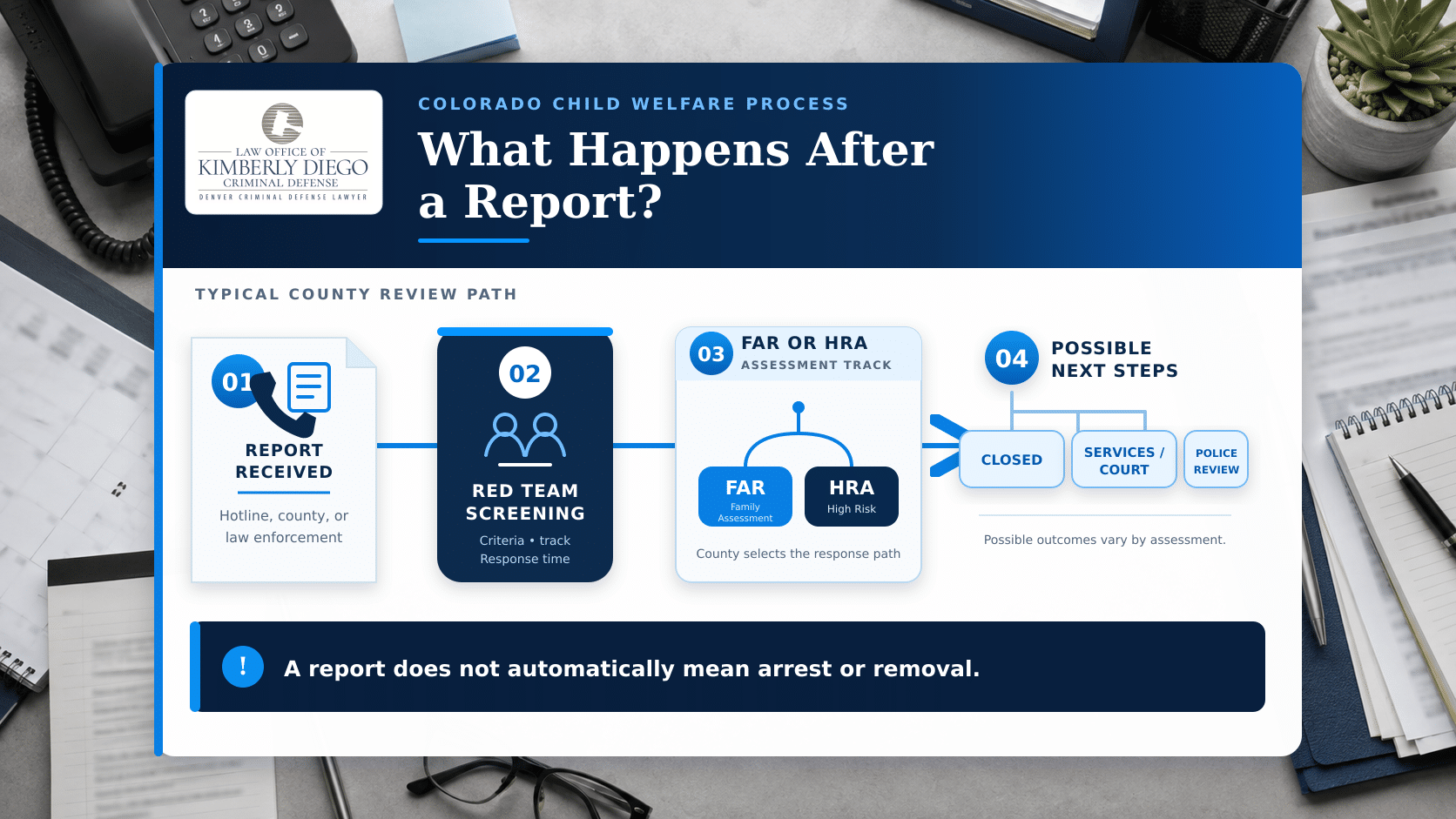
A report from a mandatory reporter does not automatically mean a parent will be arrested, charged with a crime, or separated from a child. The report is routed to the appropriate Colorado county for screening. The county may screen it out, assign it to a family-focused or high-risk assessment track, or coordinate with law enforcement when the allegations may involve a crime or an immediate safety concern.
The early stages still matter. What a parent says to a caseworker, police officer, medical provider, or school employee may later become part of a child welfare or criminal case. If a caseworker or detective has contacted you, a Denver child abuse defense lawyer can help you understand which process is underway before you provide a detailed statement or sign documents.
Who Is a Mandatory Reporter in Colorado?
Colorado law identifies a long list of professionals who must report suspected child abuse or neglect when they have reasonable cause to know or suspect it in their qualifying professional capacity. Common examples include:
- Teachers and other school employees
- Physicians, nurses, hospital personnel, dentists, and other healthcare professionals
- Mental health professionals, therapists, counselors, and social workers
- Childcare and early-childhood employees
- Peace officers, firefighters, and emergency medical service providers
- Clergy members, subject to the statute’s privilege-related exception
The legal trigger is reasonable cause to know or suspect abuse or neglect, not proof that abuse occurred. A mandatory reporter generally must make the report as soon as reasonably possible and no later than 24 hours after receiving the information. Other people may make reports voluntarily.
Colorado updated these rules through House Bill 25-1188, effective September 1, 2025. Among other changes, the law provides that a report may not be based on a family’s race, ethnicity, socioeconomic status, or disability, and concerns based solely on poverty-related conditions or disability do not trigger the mandatory-reporting duty. The changes also generally limit the duty to information learned in the professional capacity that makes the person a mandatory reporter.
What Happens After the Colorado Child Abuse Hotline Receives a Report?
Reports may be made to a county department, local law enforcement, or through the Colorado Child Abuse and Neglect Hotline at 844-CO-4-KIDS (844-264-5437). A hotline call creates a referral and routes the information to the county responsible for reviewing it. The call itself does not automatically send a caseworker or police officer to the home.
The county uses a Review, Evaluate, and Direct, or RED, Team to screen the referral. Colorado’s RED Team guidance describes a group of three to five county child welfare staff members, including at least one supervisor. The team evaluates three central questions:
- What abuse or neglect is being alleged?
- Do the allegations meet the legal and agency criteria for a child welfare response?
- If an assessment is required, how quickly must the county respond?
A referral that is screened out is not assigned for a county child welfare assessment based on the information available at the time. That decision is not the same as a court finding that an accusation was true or false, and a separate law-enforcement agency may still evaluate possible criminal conduct. If the referral is screened in, Colorado rules use different response times based on the alleged danger and circumstances.
Family Assessment Response vs. High Risk Assessment
Colorado now uses a statewide Differential Response model. According to the state’s current explanation of how Colorado responds to child abuse and neglect reports, a screened-in referral is generally assigned to one of two tracks:
- Family Assessment Response (FAR): Generally used for low- to moderate-risk situations. The focus is on child safety, family strengths, needs, and services. FAR does not require a formal finding that abuse or neglect occurred.
- High Risk Assessment (HRA): Used for serious, egregious, fatal, or near-fatal allegations and for matters involving sexual abuse or institutional abuse. The county must make a formal determination regarding whether abuse or neglect occurred.
In either track, a caseworker may contact family members, visit the home, interview the child and adults, seek records, evaluate immediate safety, and discuss services or a safety plan. The details depend on the allegations, the child’s age, the assessed risk, and whether law enforcement is involved.
A County Assessment and Criminal Investigation Are Separate
A county child welfare assessment is a civil child-safety process. A police investigation asks whether a crime occurred and whether there is probable cause to identify or charge a suspect. The two processes may run at the same time, involve overlapping witnesses and records, and reach different conclusions.
A caseworker is not acting as your criminal defense attorney, and statements made during an assessment are not automatically confidential from police or prosecutors. Reports and related information may be used in proceedings concerning child abuse, subject to applicable law. A person who may be accused should therefore understand the purpose of an interview and whether law enforcement is participating before answering detailed questions.
Early pre-filing representation can be especially important when police are still collecting evidence, and no criminal charge has been filed. Counsel may communicate with investigators, help preserve favorable records, prepare the client for necessary interactions, and work to prevent an incomplete or inaccurate account from defining the case.
Does a Mandatory Report Mean a Child Will Be Removed?
No. A mandatory report alone does not remove a child from the home or change parenting time. The county must separately evaluate safety and determine what response, if any, is justified. Many referrals do not lead to court involvement.
When the county believes a child faces an immediate safety threat, however, it may seek protective action. That can include a proposed safety plan, placement with a relative, a dependency and neglect petition, or emergency action permitted by law. Parents should not assume that a proposed safety plan is a routine form. Its terms can affect where a parent lives, who may supervise contact, and what happens next. Obtain legal advice before signing if you do not understand the terms or their consequences.
Possible Outcomes After a Child Welfare Assessment
Depending on the referral, assessment track, and evidence, possible outcomes include:
- The referral is screened out without a county assessment
- An assessment closes without further action
- The family accepts voluntary services or community resources
- The family agrees to a safety plan
- A High Risk Assessment results in a formal finding of abuse or neglect
- The county asks a juvenile court to open a dependency and neglect case
- Law enforcement continues a separate criminal investigation or prosecutors file charges
A dependency and neglect case is a civil juvenile matter focused on the child’s safety and care. A criminal case focuses on alleged violations of Colorado’s criminal code. Someone can face one process, both processes, or neither. For a broader overview of the underlying law, see our discussion of child abuse and neglect in Colorado.
What Should a Parent Do After a Caseworker or Detective Calls?
The goal is to protect both the child and your legal position without escalating the situation. Practical first steps include:
- Identify who is contacting you. Ask for the person’s name, agency, phone number, referral or case number, and whether police are involved.
- Ask what process is underway. Find out whether the referral was assigned to FAR or HRA, what is alleged, and what the worker wants you to do.
- Preserve information. Save messages, photographs, medical and school records, calendars, and other documents that may help establish an accurate timeline.
- Do not coach the child or coordinate stories. Attempts to influence what another person says can damage credibility and create additional concerns.
- Do not lie, destroy evidence, or obstruct. You may ask for time to obtain advice, but you should comply with valid court orders and avoid conduct that could worsen the case.
- Get advice before a detailed interview or signature. Understand the legal effect of releases, safety plans, written statements, and recorded interviews before agreeing to them.
What Changes If Criminal Charges Are Filed?
If prosecutors file a child abuse charge, the court will enter a mandatory criminal protection order. Its standard terms prohibit conduct such as harassment, intimidation, retaliation, and witness tampering. The judge may also impose case-specific conditions affecting contact with a child, residence, supervision, or other family interactions. Only the court can modify a court order; private agreement with the other parent or protected person does not change it.
Child abuse charges range widely based on the alleged conduct, mental state, and resulting injury. Related assault or domestic violence allegations may also be filed. The defense should evaluate the original report, the child’s statements, medical findings, interview methods, family context, and whether investigators interpreted ambiguous facts too aggressively.

Speak With a Denver Child Abuse Defense Lawyer Early
The period after a mandatory report can shape everything that follows. Even before charges exist, an attorney can help distinguish the county assessment from the criminal investigation, identify evidence that should be preserved, and prepare you for contact with agencies.
Kimberly Diego represents people facing child abuse allegations and criminal investigations in Denver and throughout Colorado. If a caseworker, detective, or prosecutor has contacted you, request a confidential case review before the next interview, home visit, or court appearance.